

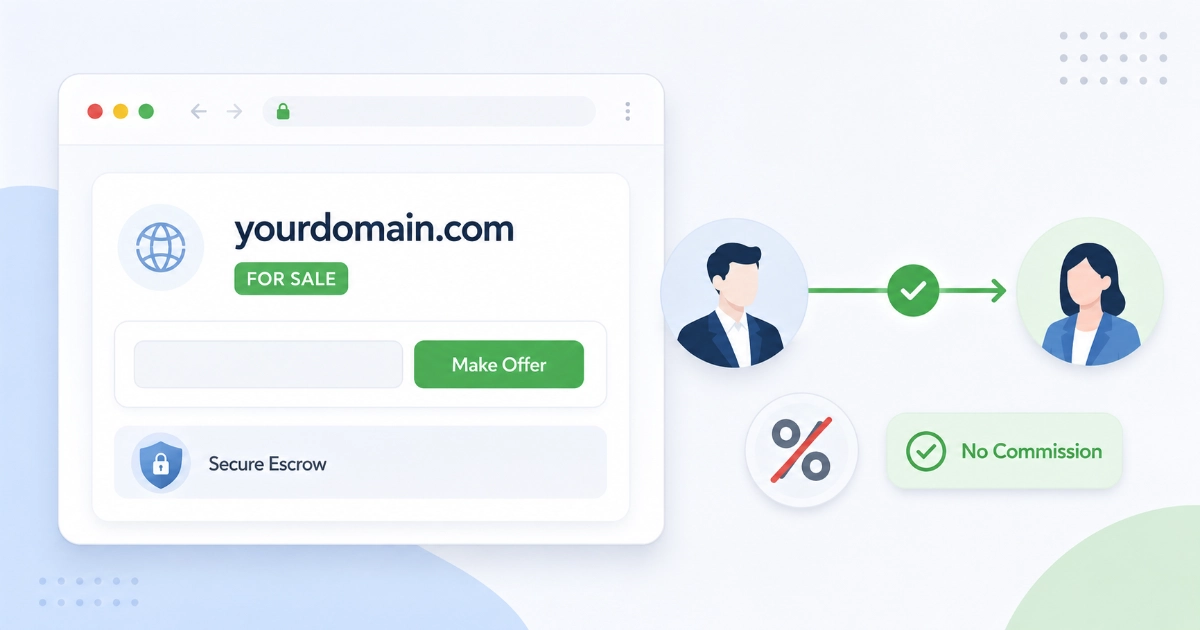

You accept $12,000 for a domain you bought for $9. The wire lands and it’s $10,200. The marketplace kept $1,800 for hosting a listing page and processing a payment. Nothing went wrong — that was the deal you agreed to.
That gap is why experienced sellers eventually build their own channel. If you want to sell domain without commission, it’s entirely doable, but it moves work onto you: the landing page, the buyer hunt, the negotiation, the transfer mechanics. This guide covers all of it, including where a marketplace is still the smarter choice.
Table of Contents
Key Takeaways
- Selling directly avoids percentage-based marketplace commissions, which commonly run from roughly 10% to 30% of the gross sale price.
- “No commission” is not “no cost.” Hosting, payment processing, escrow, and transfer fees still apply.
- A direct seller needs a credible landing page and a buyer-acquisition plan; without both, the domain sits unsold.
- Price on comparable sales, commercial intent, and end-user fit — automated appraisals are one input, not a valuation.
- Targeted outreach to businesses that would logically use the name beats broad promotion, within anti-spam laws and platform rules.
- Escrow reduces transaction risk. Escrow.com’s domain fees start at 2.6% with a $50 minimum up to $5,000 (checked 18 July 2026).
- Marketplaces stay worthwhile when you need distribution, brokerage help, or don’t want to manage inquiries and transfers.
1. Understand What “Selling Without Commission” Really Means
Commission is a percentage of the final sale price. It scales with your success, which is what makes it sting on a five-figure sale. Everything else is either a flat cost or a small percentage tied to a specific service.
Five cost types get muddled in most discussions of this topic:
- Percentage commission — the marketplace’s cut. This is what direct selling eliminates.
- Flat listing fees — fixed regardless of sale price. Flippa’s starts at $29 for sub-$10K assets, separate from its success fee (Flippa, Pricing).
- Operating costs — hosting, email, payment processing. Modest, and yours either way.
- Transaction costs — escrow and registrar transfer fees, which exist in direct sales too and are often paid by the buyer.
- Your time — outreach, negotiation, and transfer coordination: unpaid labour a commission would otherwise buy.
Free tools help, but a free plugin doesn’t make the sale free. It removes the percentage, not the overhead.
2. Why Domain Marketplaces Charge Commission
The commission isn’t arbitrary. It pays for infrastructure most individual sellers can’t replicate:
- Buyer traffic from people who arrive already intending to purchase
- Registrar and reseller distribution, surfacing your domain during someone else’s checkout search
- A trusted brand that reassures a buyer sending $20,000 to a stranger
- Payment handling, escrow integration, and fraud screening
- Brokerage on larger deals, and transfer help for first-time buyers
Published rates vary by platform and listing type, and they change. Sedo’s price list describes tiers from about 10% for a Buy Now sale on its own sales page up to 20% through its partner network (Sedo, Price List). GoDaddy’s aftermarket announcement set 15% for domains pointed to Afternic, Dan, or Uniregistry nameservers and a higher rate for domains pointed elsewhere (GoDaddy, Aftermarket Commission Model Update). Flippa lists a 10% success fee on top of its listing fee. Check current terms before listing — these numbers move.
Sell direct and you take over every one of those functions. That’s the honest trade.
3. Decide What the Domain Is Worth
Pricing is where most direct sales die. Too high and nobody replies. Too low and you’ve donated the difference.
What actually drives value
Start with comparable sales for similar names — same extension, similar length, similar industry. Adjust for extension (.com still commands a premium), length, memorability, spelling difficulty, commercial intent, and search demand. Type-in traffic or genuine backlinks add value. Trademark exposure subtracts it, sometimes to zero.
The biggest split is wholesale versus retail. An investor buying to resell pays wholesale, often a fraction of retail. An end user who wants that exact name for a business they already run pays retail, because for them it’s an asset rather than inventory. Direct selling is a retail strategy — price at wholesale and you’ve done the extra work for none of the upside.
Four numbers to define before you talk to anyone
- Asking price — what you publish or open with
- Target price — what you expect to close at
- Minimum — the lowest you’d sign, never disclosed
- Walk-away price — below this you keep and renew the domain
An example: you own a two-word .com in a services niche, and comparables have sold at $3,000–$6,000. Set asking at $6,500, target $4,500, minimum $3,200, walk-away $2,800. Every offer now has a frame, and you’re not doing arithmetic while emotionally invested in a reply.
Automated appraisals are one data point. They read patterns, not the buyer in front of you — use them to sanity-check a range, never to set the number. On fixed price versus make-an-offer: a published price filters tyre-kickers and closes faster, while make-an-offer keeps the ceiling open when one buyer values the name far above comparables.
4. Build a Commission-Free Domain Sales Landing Page
Your landing page is the entire storefront. A buyer who types the domain in and hits an ad-filled parked page, or a registrar error, is gone.
An effective page shows the domain name prominently, states plainly that it’s for sale, gives a price or offer form, adds two or three lines on commercial value, and explains how the transaction works including escrow. It needs HTTPS and a mobile layout that doesn’t collapse. Keep personal contact details off the page; route inquiries through the form.
Using WordPress and the Domain For Sale plugin
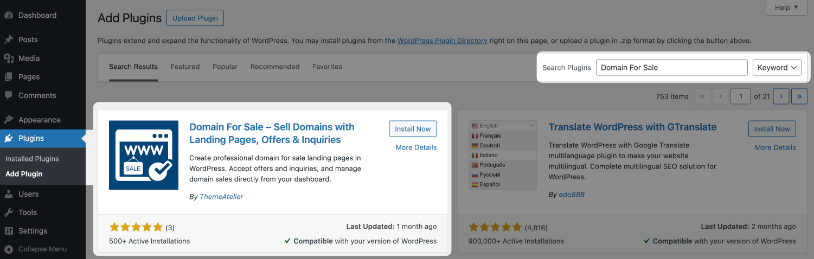
If you already run WordPress, the Domain For Sale plugin handles the mechanics without custom development. It creates dedicated landing pages for individual domains, showcases a portfolio, and includes a built-in offer and inquiry form. Submissions land in a dashboard you can search and filter, with admin email notifications on arrival. It supports bulk import via CSV, XML, or JSON, works with Gutenberg and the major page builders, and is responsive by default. The core plugin is free, with a paid Pro tier.
The benefit is control: your presentation, your wording, inquiries to your inbox, and no percentage on the way out.
Setup sequence
- Point the domain’s DNS to your WordPress install.
- Install and activate the Domain For Sale plugin.
- Set the asking price, or switch to offer-only.
- Write a short value proposition — who the name suits and why.
- Configure the inquiry method and notification email address.
- Test page and form on desktop and mobile.
- Submit a test inquiry and confirm the email arrives, spam folder included.
- Add a line describing your escrow and transfer process.
Step seven isn’t optional. Silently broken contact forms are the most common reason a for-sale page produces nothing.
5. Find Buyers Without Paying for Marketplace Exposure
Broad promotion tells the world your domain exists. Targeted outreach tells one company why it matters to them. The second converts; the first mostly doesn’t.
Free and low-cost channels worth working:
- Type-in traffic to your landing page — small, but the highest-intent visitors you’ll get
- Domain investor forums, for wholesale interest and price sanity checks
- Niche business communities and industry associations in the vertical
- LinkedIn, X, and wherever the industry congregates
- Founder communities, especially around naming and rebrand discussions
- Targeted outbound email to a short, researched list
- Your professional network, consistently underused
Say you own CoastalRoofing.com. Your buyer list isn’t “roofers.” It’s coastal roofing contractors operating on a hyphenated domain, a long descriptive one, or a name that doesn’t match their trading name. Twenty minutes of local search produces fifteen real prospects — better than a thousand-address blast. Stay inside anti-spam rules such as CAN-SPAM and GDPR, use business addresses, and follow up once at most.
6. Conduct Direct Outreach Without Sounding Like a Spammer
Good outreach is short and specific: why this recipient, the domain, one real benefit, a price or an invitation to discuss, and an easy reply. No countdown timers, no invented competing bidder.
Subject: CoastalRoofing.com — available if it’s useful to you
Hi Dana,
I noticed Coastal Roofing Services runs on coastalroofingservicesnc.com. I own CoastalRoofing.com and I’m selling it. The shorter name is easier to say on a call and on a truck, and it matches how customers already search for you.
Asking price is $6,500, handled through Escrow.com so the transfer is protected both ways. Happy to answer questions — and no problem at all if it isn’t of interest.
Best,
Sam
That last line matters. Permission to say no is what keeps the email from reading like pressure.
7. Negotiate Directly
First, qualify. A serious inquiry comes from a business address, mentions a use case, and asks about process. A one-line “how much?” from free webmail is often a reseller fishing for wholesale — worth answering, worth pricing accordingly.
Never disclose your minimum. Asked for your lowest price, restate the asking price and invite an offer. Low offers are normal — not insults, not necessarily fraud. Answer with a counter.
A realistic exchange on that $6,500 asking price:
- Buyer: “Interested, but $6,500 is beyond our budget. We could do $2,000.”
- Seller: “Thanks — $2,000 is below comparable sales for this type of name. I can do $5,200, transfer handled through Escrow.com.”
- Buyer: “$3,500 is what we can approve.”
- Seller: “Let’s close at $4,200, escrow fee split. I can hold that until Friday.”
That lands above minimum with every term explicit. Put the agreed price, fee split, and timeline in writing before anything moves. An expiry date helps when a buyer stalls, but only use one you’ll honour. Slow down for pressure to move off escrow, requests to transfer before funds are secured, or a buyer supplying their own “escrow” link.
8. Use Escrow to Complete the Sale Safely
Escrow exists because neither side wants to go first. The provider holds the money, you transfer, funds release on confirmation.
- Both sides agree price and terms in writing.
- One party opens the transaction with a reputable escrow provider; the other accepts.
- The buyer funds the escrow account.
- Only after funding is confirmed, the seller transfers — registrar transfer with an authorization code, or an account push if both use the same registrar.
- The buyer confirms control, or the inspection period expires.
- Funds release to the seller.
Escrow.com’s domain fees are tiered by size, starting at 2.6% with a $50 minimum up to $5,000 and falling as values rise (Escrow.com, Fee Calculator, checked 18 July 2026). Some providers offer flat fees instead. On a $4,200 sale that’s roughly $110, against the $630 a 15% commission would have taken. Decide who pays before agreeing the price.
Verify the provider independently. Type the escrow URL yourself rather than clicking a buyer’s link, and check the spelling — fake escrow sites imitating real ones are a long-running fraud. Remove the transfer lock and have the authorization code ready before promising a timeline. Large transactions may trigger extra identity checks. Escrow reduces risk substantially; it doesn’t eliminate it.
9. Common Mistakes to Avoid
- Pricing entirely from an automated appraisal
- An unprofessional or ad-cluttered landing page
- Burying the fact that the domain is for sale
- Never testing the inquiry form or notification emails
- Mass-emailing unrelated companies
- Selling names that infringe a trademark
- Accepting instalments or overpayment schemes
- Transferring before payment is secured in escrow
- Using an escrow link supplied by an unverified buyer
- Leaving price, fee split, and timeline undocumented
- Sounding desperate, or arguing with a low offer
- Assuming no commission means no expenses
10. When a Marketplace Still Makes Sense
Direct selling isn’t universally better. A marketplace earns its commission when you have no outreach plan, when the domain benefits from registrar distribution that puts it in front of buyers mid-search, when a deal needs a broker, when the name is hard to price, or when you’d rather pay a percentage than manage inquiries and transfers. Convenience is a legitimate thing to buy.
| Factor | Marketplace | Direct sale |
|---|---|---|
| Cost per sale | Commission, plus any listing fee | Hosting, escrow, transfer fees |
| Buyer reach | Built-in traffic and distribution | Only what you generate |
| Workload | Low — list and wait | High — outreach, negotiation, transfer |
| Control | Platform sets the process | You set terms and presentation |
| Buyer trust | Borrowed from the platform | Built by your page and escrow |
| Best for | Portfolios, hard-to-price names | Names with an identifiable end user |
Running both is common: a marketplace listing for passive exposure alongside your own page. Read the listing agreement first — some are exclusive, some require specific nameservers, and some bind you to commission on any sale during the term.
11. Step-by-Step Commission-Free Selling Checklist
- Research comparable sales and check for trademark conflicts.
- Set asking, target, minimum, and walk-away prices.
- Decide between a published price and make-an-offer.
- Point the domain to WordPress and build the landing page.
- Confirm HTTPS, mobile layout, and form delivery with a live test.
- Publish your transaction process and escrow choice.
- Build a researched prospect list of likely end users.
- Send short, specific outreach emails. Follow up once.
- Qualify inquiries and negotiate to a written agreement on price, fee split, and timeline.
- Open escrow with a provider you verified independently.
- Wait for funding confirmation before transferring anything.
- Remove the transfer lock, supply the auth code or push the account, confirm transfer.
- Collect funds, keep records for tax, remove the listing.
Frequently Asked Questions
Can I really sell domain without commission?
Yes. Find the buyer yourself and handle the transaction outside a marketplace, and no percentage commission applies. Escrow, transfer, and hosting costs remain, and you do the work the marketplace would.
Is selling a domain directly safe?
Reasonably, with a reputable escrow service and written terms. The main risks — fake escrow sites and transferring before payment clears — are avoidable. No process removes risk entirely.
How do I receive payment for a private domain sale?
Through escrow: the buyer funds, you transfer, funds release after confirmation. Direct bank transfer only suits buyers you already know.
Should I display a fixed price or use “make an offer”?
A fixed price filters casual inquiries and closes faster. Make-an-offer preserves upside when one buyer may value the name far above comparables.
Do I still need escrow if I trust the buyer?
Above a token amount, yes — roughly $100 on a $4,000 sale, cheap insurance against a reversed payment.
Can I list on a marketplace and my own website at the same time?
Often yes, but read the listing agreement. Some are exclusive, some require specific nameservers, and some claim commission on any sale during the term.
Where to Start
Choosing to sell a domain without commission is a trade, not a shortcut. You give up marketplace distribution and convenience for control over pricing, presentation, and how much you keep. For names with an identifiable end user, that trade usually favours the seller.
Build the infrastructure before contacting anyone. A credible landing page, tested inquiry delivery, and a decided escrow process take an afternoon, and they turn interest into a closed sale rather than an unanswered email. If your domains are on WordPress, the Domain For Sale plugin is a practical first step.
General educational information, not legal, tax, or financial advice. Marketplace commissions, escrow pricing, and registrar policies change — verify current terms with the provider before relying on them. Fee figures here were checked on 18 July 2026.