

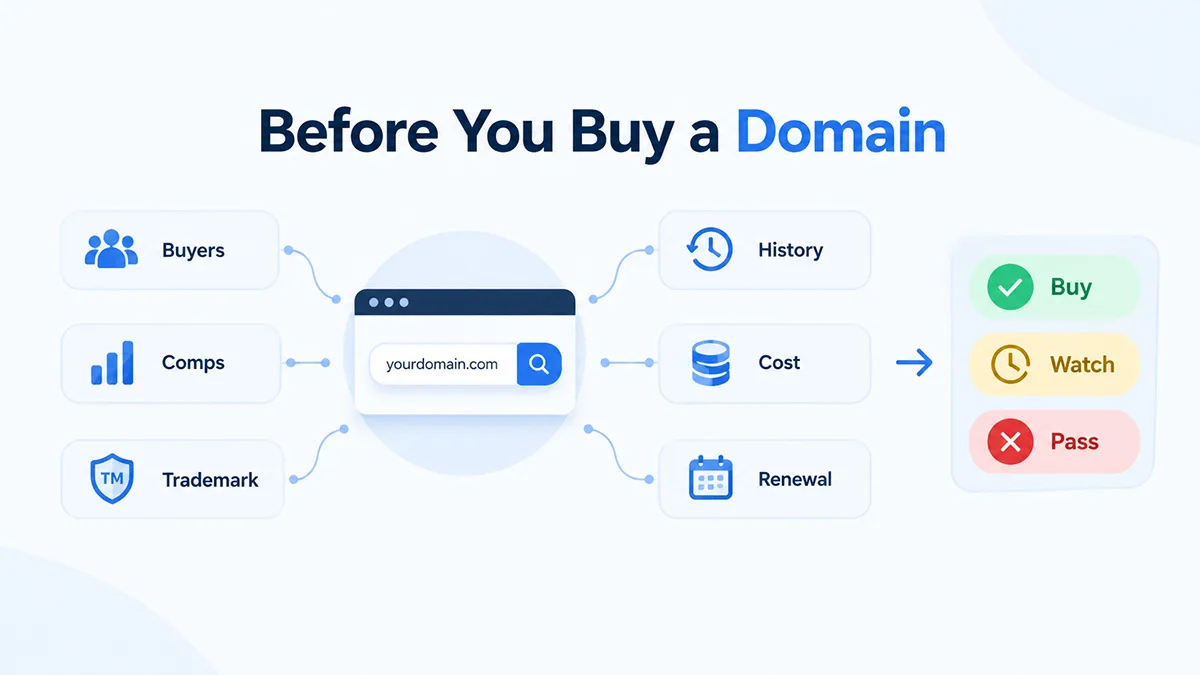

You find a domain. It sounds clean, the extension feels right, and it’s sitting in an auction or available to register right now. The temptation hits immediately: “This feels valuable — I should grab it before someone else does.” That feeling is exactly where beginners accumulate renewal bills.
The better question isn’t “is this a nice domain?” It’s: who could realistically buy this name, what evidence actually supports that idea, and what’s the maximum amount worth risking to acquire it? This guide walks through a repeatable domain buying checklist — the kind of process that separates domains worth buying from ones that just look good — so you can answer that before you spend money.
wpdomainforsale.com is operated by ThemeAtelier, the developer of Domain For Sale. This guide focuses on a conservative research process for evaluating domain acquisitions — it does not predict whether a particular name will sell or what return it will produce. Domain investing carries real financial risk, a domain may never resell, and trademark or legal questions may warrant professional advice. Nothing here is financial, investment, or legal advice.
Key Takeaways
- A good domain isn’t automatically a good investment at every acquisition price — the price you pay is part of the thesis, not separate from it.
- Start by identifying plausible buyers, not by running an automated appraisal number.
- Comparable completed sales are more useful than asking prices, but the comps have to actually be comparable.
- Wholesale acquisition prices and retail end-user sale prices represent different markets — don’t treat one as a proxy for the other.
- Renewal fees matter, because a domain that doesn’t sell keeps costing money every year it sits unsold.
- Trademark risk can turn an apparently valuable name into a liability — this is a screening step, not an afterthought.
- Domain age, backlinks, and past use all require verification; none of them are automatic value on their own.
Table of Contents
Value and a Good Buy Aren’t the Same Thing
A domain can be genuinely good and still be a bad acquisition at the asking price. Hypothetically, a name that might plausibly sell to an end user for $2,500 isn’t automatically an attractive buy at $2,200 — that margin doesn’t account for uncertainty, the holding period, renewals, transaction costs, sales venue fees, opportunity cost, or the real possibility it never sells at all.
Domain investing is illiquid — a domain can sit unsold for years, so acquisition discipline and carrying costs matter as much as the name itself. The real question isn’t “is this a nice domain?” It’s “is this domain attractive enough at this specific acquisition price to justify the risk?”
Check 1: Can You Identify Realistic End Users?
Before checking appraisal tools or admiring the spelling, ask: who might actually pay to own this exact domain? Try to name five to ten plausible businesses, industries, or products that would fit the name — not a vague “any business could use this.”
One caution: a buyer pool built entirely on “Company X might have to buy this from me” is a legal warning sign, not an investment thesis — more on that below. Buyer quality matters more than buyer count. Ten tiny hobby projects represent less real demand than three funded commercial companies. Ask whether the use is commercially meaningful, whether the buyer has alternatives, and whether owning this name would materially improve their positioning. Don’t invent a buyer’s budget — this is a qualitative screen, not a spreadsheet.
Check 2–4: Does the Name Survive a Quick Screen?
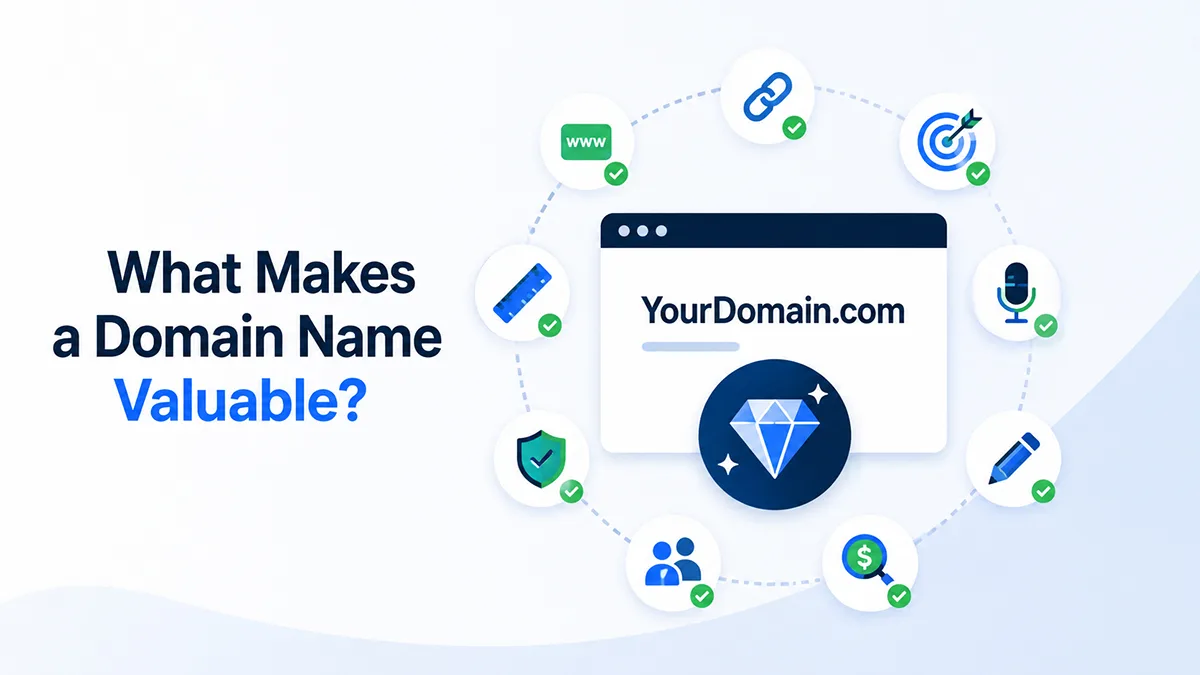
Three fast checks help you evaluate domain name quality before you go deeper: does the name work without explanation, does the extension fit the buyer, and is the commercial use real rather than assumed? A domain requiring a spelling correction, an awkward hyphen, or a clarifying sentence rarely survives contact with a real buyer.
- Name quality: check spelling, pronunciation, word order, and memorability quickly — this is covered in depth in our domain value guide, so we won’t repeat it here.
- Extension fit: avoid assuming “.com is always valuable.” A country-code or niche technology extension can fit a specific market well; the fit to your identified buyer matters more than the extension in isolation.
- Real commercial use: search interest, commercial demand in a category, and an actual company willing to pay for this specific name are three different things. High search volume is one clue, not the investment thesis.
Check 5: Run a Trademark and Legal Risk Screen
Registering a domain doesn’t grant trademark rights, and this check deserves more attention than a quick glance at the name’s history. Search the exact phrase against reputable sources — the WIPO Global Brand Database and relevant national trademark registries are reasonable starting points — and search the general web for existing businesses using the name. This is screening, not legal advice, and a database search isn’t the same as legal clearance.
If the domain exactly matches a famous brand, appears designed to capture brand confusion, or seems to have obvious value only to one trademark owner, the right move is Pass, or qualified legal advice before proceeding. It’s worth knowing about the Uniform Domain Name Dispute Resolution Policy (UDRP) — an administrative process created by WIPO and adopted by ICANN that lets trademark owners challenge domain names registered and used in bad faith, without going to court. A trademark conflict isn’t a hidden opportunity; it’s acquisition risk.
Check 6: Pull Comparable Completed Sales — Carefully
A similar domain listed for $40,000 tells you nothing on its own — asking prices aren’t completed transactions. Look instead for several actual completed sales matching on TLD, word count, length, category, and style; a database like NameBio aggregates publicly reported sales and is a reasonable starting point for this research. One dramatic sale is not enough to build a thesis on.
Two things to keep in mind. First, wholesale and retail comps are different markets: wholesale is investor-to-investor pricing (expiry auctions, reseller marketplaces), while retail is a sale to an end user who wants the name for actual use — and retail prices can run much higher. Don’t take a hypothetical $5,000 retail sale and conclude $4,000 is a good investor acquisition price; the gap needs to cover risk, time, and uncertainty. Second, public sales databases have blind spots — private sales, confidential brokered deals, and unreported transactions don’t appear in them, so comps are evidence, not a mathematical price guarantee.
Checks 7–9: Do the Math Before You Bid
The purchase price is not the only cost, and this is where beginners most often skip steps. Calculate your all-in acquisition cost — auction price, registrar transfer and renewal fees, any auction or backorder fee, and currency or payment processing fees — rather than budgeting off the headline bid alone.
Then model the carrying cost of not selling right away. A hypothetical $15/year renewal held for 3 years is $45 in carrying cost on one domain — multiply that across a 100-domain portfolio and the economics change substantially. A cheap hand registration can become an expensive inventory item once you multiply it across years and a portfolio. Also check the domain’s actual renewal pricing at the registry level before bidding — some extensions carry premium or non-standard renewal costs, and a discounted first-year registration price is not the ongoing rate.
Finally, decide your maximum acquisition price before an auction starts, and don’t raise it because someone else bid, the auction feels competitive, or you’ve already sunk time into research. There’s no single universal formula — your margin should reflect your own resale thesis, acquisition and holding costs, and risk tolerance, and it will differ from another investor’s.
Acquisition Worksheet
Fill this out for any domain before you bid or buy — it’s the working core of the domain buying checklist.
| Input | Your Estimate |
|---|---|
| Acquisition price / current bid | $______ |
| Immediate fees (transfer, auction, backorder) | $______ |
| Annual renewal (verified, not promo rate) | $______ / year |
| Planned holding horizon | ____ years |
| Estimated total carrying cost | $______ (renewal × years) |
| Conservative comparable range | $______ – $______ |
| Likely buyer type | End user / Investor |
| Number of plausible buyers | |
| Major legal / history risks | None / Trademark / Spam history |
| Maximum acquisition price | $______ |
| Decision | Buy / Watch / Pass |
Checks 10–11: Registration Data and Historical Use
As of January 28, 2025, RDAP (Registration Data Access Protocol) replaced WHOIS as the definitive source for generic top-level-domain registration data, per ICANN. ICANN’s public RDAP lookup tool can help identify current registration information, though privacy rules limit which registrant fields are publicly visible — some non-public data now requires going through a formal request process rather than a plain lookup.
For aged or expired domains, also check historical use through a resource like the Internet Archive’s Wayback Machine: what site existed before, did its topic change repeatedly, and was it ever used for spam, malware, gambling, adult content, or suspicious redirects? Archived snapshots aren’t complete or infallible, but a clean history is a useful data point. A crucial caution: don’t assume old expired domains carry SEO authority forward. Google’s own spam policies explicitly address expired domain abuse — defined as “an expired domain name is purchased and repurposed primarily to manipulate search rankings by hosting content that provides little to no value to users.” A clean history is a nice characteristic. It’s not a ranking guarantee.
Checks 12–13: Backlink Quality and Name Variants
If the domain has backlinks, check quality, not count. Ten thousand backlinks means little if they’re spam, automated, or sitewide junk links — one legitimate, relevant, editorially-earned link profile is worth more than a large pile of low-quality ones. Even clean backlinks don’t guarantee rankings, an SEO value transfer, or a higher resale price.
Separately, search the exact name and its close variants — common misspellings, plural/singular forms, hyphenated versions, and how similar businesses use the term. You’re looking for signs of real demand, confusion, existing brands, or negative associations. Don’t register typo variants of existing brands as a strategy; that’s the trademark risk from Check 5 again, not a shortcut around it. For the mechanics of running a WHOIS/history search and a basic trademark check, our beginner’s guide to what to know before buying a domain walks through the steps.
Check 14: Decide Your Exit Path Before You Buy
If you acquire this domain, how would a buyer actually discover it — a marketplace listing, your own portfolio page, a sales lander, an inbound inquiry, or outbound prospecting? No channel guarantees a sale. But if you can’t describe a likely buyer and a plausible route to reach them, the acquisition thesis is probably incomplete, regardless of how clean the name looks.
Where to Find Acquisitions, and Auction Discipline
If you buy domains for resale regularly, you’ll draw from a few common acquisition sources: fresh registrations at a registrar, expired-domain auctions, pending-delete/drop opportunities, backorder or drop-catch services, and buying directly from another investor. No single source is universally best — research the specific platform’s rules before relying on it.
Before entering any auction, complete your due diligence first, define your maximum bid in advance, and don’t chase the price up emotionally just because bidding feels competitive. Auction rules vary by platform — understand them before you bid, not mid-auction.
The Domain Buying Checklist Decision Framework: Buy, Watch, or Pass
This is where the domain buying checklist becomes a decision: skip a fake numeric “domain score” — an 8 out of 10 doesn’t mean a valuable domain. Rate each category green, yellow, or red instead: buyer demand, name quality, extension fit, legal risk, history, comps, and acquisition economics. Then decide.
- Buy — when there’s a credible buyer pool, clear use, a clean legal screen, acceptable history, sensible comps, and the acquisition price leaves meaningful margin against a manageable carrying cost.
- Watch — when the name is interesting but the price is too high, the research is incomplete, or the buyer pool is still unclear.
- Pass — on obvious trademark risk, toxic or spam history, no plausible end users, a poor name-to-TLD fit, high recurring premium renewal, a price that leaves no risk margin, or a thesis that relies entirely on an automated appraisal number.
Worked Example (Illustrative Only)
Here’s the domain buying checklist applied to a fictional example. Illustrative example only — no claim of availability or value. Say you’re considering the fictional domain “CedarLoopStudio.com,” listed at auction for $180.
- Buyer pool: plausible for a design studio, small architecture practice, or creative agency — a handful of realistic categories, not “any business.”
- Name and extension: reads cleanly, no hyphen or spelling trap, .com fits a broad commercial buyer.
- Trademark screen: no exact match found in a quick brand-database and web search; not designed around an existing brand.
- Comps: three or four completed sales of similarly structured two-word .com names in the creative/studio space, in a modest range — not one dramatic outlier.
- Acquisition cost and renewal: $180 bid plus transfer fee, standard (non-premium) annual renewal confirmed at the registry.
- History: never previously registered; nothing to screen.
- Exit path: portfolio listing plus outbound emails to a short list of plausible studios.
- Maximum price and decision: comps and buyer pool support bidding up to a self-set ceiling above $180 — call it Buy, up to that ceiling, and Pass beyond it.
Notice this doesn’t end with a made-up “true market value” — the point is demonstrating the reasoning, not producing a number.
What About Automated Appraisals?
Appraisal tools can offer a reference point or a standardized comparison, but they can’t know exact buyer motivation, future demand, legal clearance, private sale data, or the margin you personally require. An appraisal of $4,000 on a domain costing $100 doesn’t automatically mean a $3,900 profit opportunity — treat it as one input among several, not the thesis itself.
Common Beginner Mistakes

- Buying because the name “sounds cool” before identifying any buyers.
- Relying on an automated appraisal value alone.
- Using one famous comparable sale to justify a price.
- Confusing a retail comp with a safe acquisition price.
- Skipping renewal-cost math, especially on premium-priced extensions.
- Chasing an auction price up emotionally.
- Treating domain age or backlink count as automatic value.
- Skipping trademark research, or buying typos of known brands.
- Assuming a registration discount is the ongoing renewal rate.
- Accumulating dozens of weak names just because each one is cheap.
Frequently Asked Questions
How do I know whether a domain is worth buying to resell?
This domain buying checklist works by combining plausible buyers, comparable completed sales, all-in acquisition cost, and legal risk — not any single factor alone. If those four line up at your acquisition price, it’s worth serious consideration.
What makes a good domain for flipping?
Clarity, memorability, a fitting extension, and real commercial relevance all matter — see our domain value guide for the full breakdown of these fundamentals.
Should I buy domains based on automated appraisal values?
No — use appraisal tools as one reference point, not the deciding factor. They can’t know actual buyer motivation, legal clearance, or your required margin.
Are expired domains better for flipping?
Not inherently. Research the domain’s history, actual demand, and legal risk, and confirm renewal cost — an expired domain’s age alone doesn’t make it a better acquisition.
Does domain age make a domain more valuable?
Not automatically. A clean, verified history is a reasonable characteristic to note, but Google’s own spam policies explicitly caution against expired domains being repurposed to manipulate rankings — age alone isn’t SEO authority.
How much should I pay for a domain I want to resell?
There’s no universal percentage. Work backwards conservatively from your comps, all-in acquisition cost, carrying cost, and required margin to set a maximum price before you bid.
Conclusion
Before buying the next domain that catches your eye, run it through this domain buying checklist in full: identify plausible buyers, credible comps, manageable costs, a clean legal and history screen, and a sensible maximum acquisition price. If any of those don’t line up, the correct decision may simply be Pass. Missing one domain costs nothing — owning a weak one costs renewal fees every year.
Once you’ve bought a domain that clears this checklist, the next step is pricing it correctly (see our domain pricing guide) and giving it a proper sales page so real buyers can find and act on it. Domain For Sale is ThemeAtelier’s WordPress tool for that selling stage — see our landing page setup guide when you’re ready.