


A domain becomes valuable when a real buyer has a strong reason to own that exact name and can’t easily replace it with an equally good alternative. That’s the whole answer to what makes a domain valuable — everything else is detail. No single formula decides it: not length, not age, not the extension, not a keyword tool’s search numbers.
Instead, value comes from two things working together: the quality of the name itself and the number, motivation, and budget of plausible buyers. An attractive name with no realistic buyer may have little resale value, while a commercially useful name can be worth real money even if it isn’t especially short. The nine factors below give you a practical framework for judging any domain — including the one sitting unused in your registrar account.
Key Takeaways
- A domain’s value depends on its usefulness to credible buyers, not merely its registration age or original purchase price.
- Short, clear domain names are generally easier to remember, type, and promote, but length alone doesn’t create value.
- .com often attracts broad commercial demand, while country-code and specialized extensions can be valuable when they closely fit the target market.
- Commercial keywords can improve clarity and buyer interest, but they don’t guarantee search rankings.
- Clean history and low legal risk protect value; spam, misleading use, or trademark conflicts reduce it.
- Comparable completed sales are more useful than asking prices or automated appraisals when estimating a realistic range.
Table of Contents
What Makes a Domain Valuable? The Buyer-First Framework
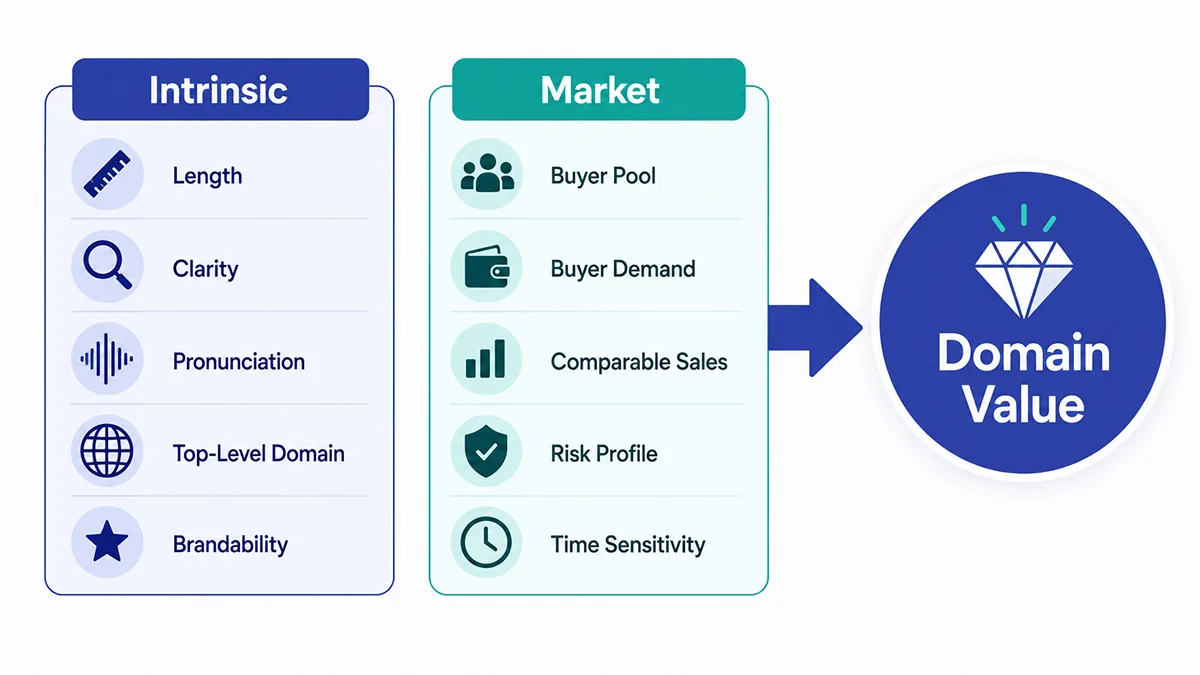
Every factor in this article falls into one of two groups. Intrinsic qualities live in the name itself: length, clarity, pronounceability, extension, memorability, and brandability. Market qualities live outside it: plausible buyers, commercial use, buyer budgets, comparable alternatives, comparable sales, legal risk, and any existing history or traffic.
Neither group works alone. A beautifully constructed name with no realistic buyer may never sell, and a commercially useful term with poor spelling, a weak extension, or serious legal risk can be just as hard to move. When you evaluate a domain, you’re really asking one question from the buyer’s chair: who needs this name, and what would replacing it cost them?
1. Length and Simplicity
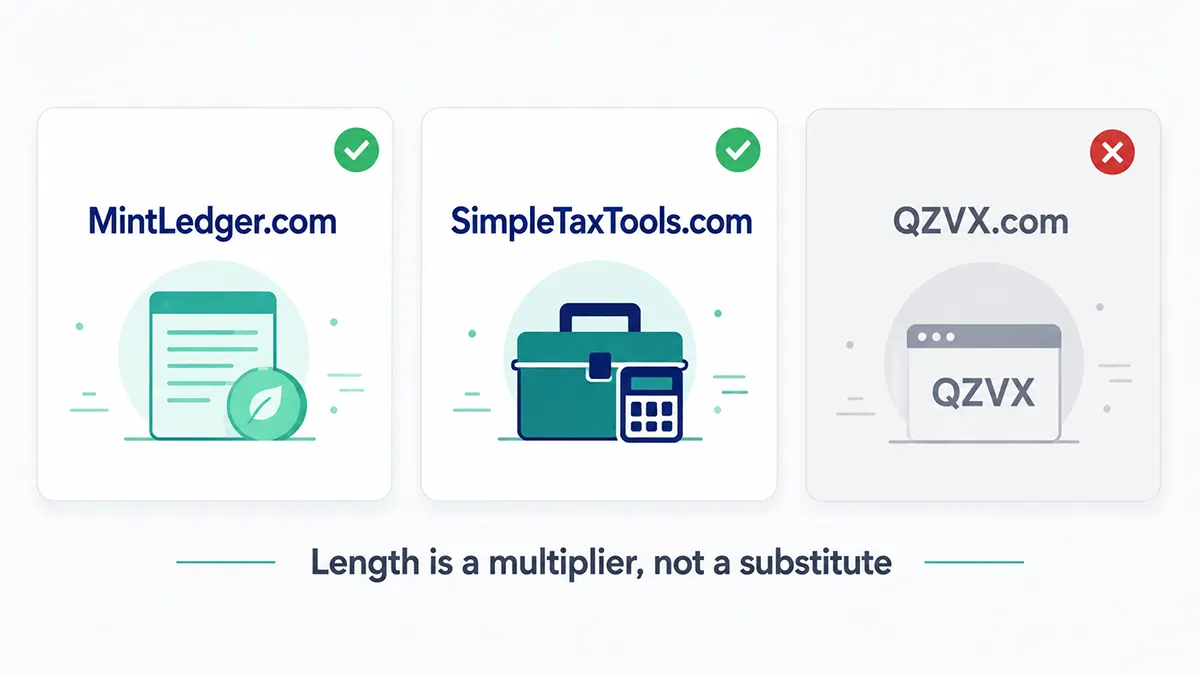
Shorter domains usually attract more buyer interest for practical reasons: they’re easier to remember, type, say in conversation, and fit into a logo or advertisement, with fewer typing errors along the way. Every extra word or character adds a little friction.
But shorter isn’t automatically better. Compare three hypothetical names: MintLedger.com and SimpleTaxTools.com both suggest obvious commercial uses, while QZVX.com — shorter than either — is a random string that means nothing to most buyers. Depending on the market, the two longer names may have far clearer buyer pools than the four-letter one. Length is a multiplier on a meaningful name, not a substitute for meaning.
Practical Test
Can someone remember the name after seeing it once?
2. Extension and Market Fit
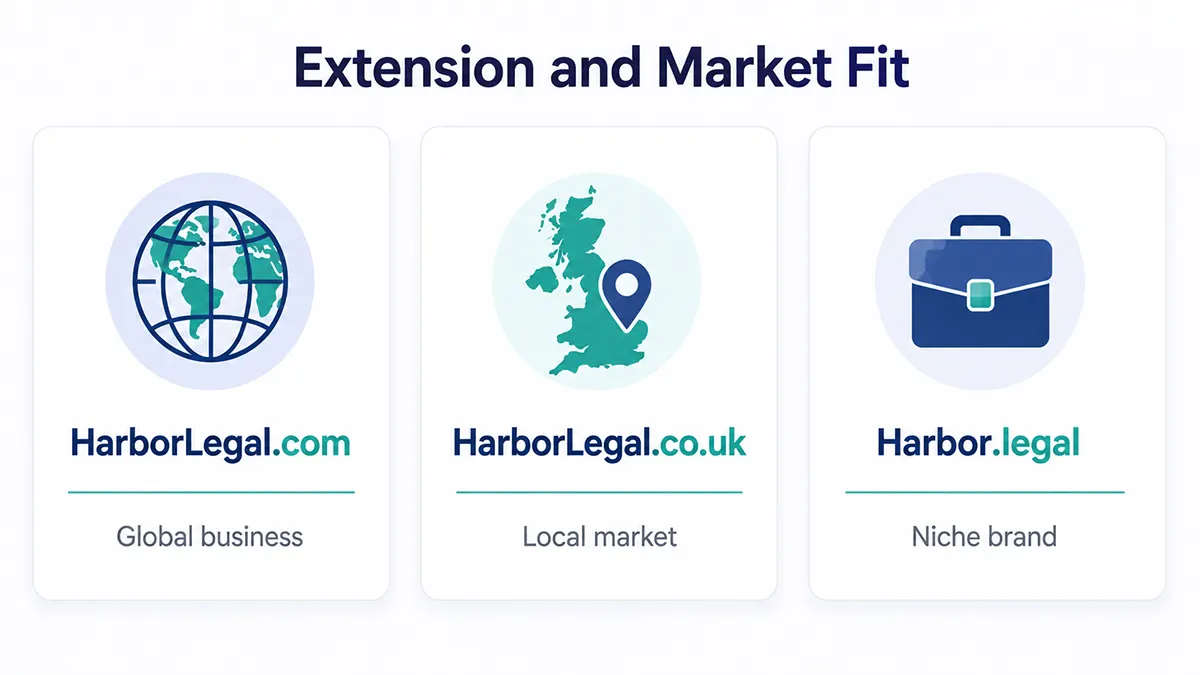
The extension — formally the top-level domain, or TLD — is the ending after the final dot: .com, .org, .net, .de, .co.uk, .io. Among these, .com carries the strongest general commercial demand: broad public familiarity, decades of business use, strong resale liquidity, and buyers who simply prefer owning the .com version of their brand. That said, plenty of .com registrations are worth nothing, because the name itself has no buyer.
A country-code TLD (ccTLD) such as .de or .co.uk can be the stronger choice when the buyer operates mainly in that country and local customers recognize the extension. Specialized endings can work when the extension reinforces the use and the target community recognizes it. Consider hypothetical variants: HarborLegal.com, HarborLegal.co.uk, and Harbor.legal each suit a different buyer, country, and brand plan. One caution that applies to all of them: no extension earns an automatic search-ranking advantage just by existing.
3. Commercial Keywords and Buyer Demand
Valuable keywords usually describe a product, service, profession, customer problem, or a location paired with a service — hypothetically, names like FleetInsurance.com, AustinRoofRepair.com, or InvoiceAutomation.com. A keyword helps because buyers instantly understand the intended use, the name reduces explanation in advertising, and multiple businesses may compete in the category.
Handle search demand carefully, though. Search volume is one clue that people care about a subject, but it says nothing about buyer budgets, brand suitability, legal safety, or a sale price — and an exact-match domain (one that matches a search phrase word for word) does not automatically rank for that phrase. Search engines evaluate the website and its content, not the domain string alone, as Google’s own guide to its ranking systems makes clear. Value the commercial meaning, not the keyword-tool number.
Practical Test
Can you list several legitimate businesses that could benefit from owning this name?
4. Brandability and Distinctiveness
A brandable domain works as a company identity rather than a description: it may be invented, combine familiar words, or suggest a feeling instead of naming a category. Hypothetical examples: Lumora.com, BlueOak.com, NestPilot.com. A strong brandable can outperform a keyword-heavy name because it feels distinctive, supports multiple products, avoids sounding generic, and — subject to proper legal review — may be easier to protect as a brand.
The limits matter. Random letters aren’t automatically brandable, difficult spelling drains usefulness, an invented word still needs to sound intentional, and anything resembling a famous existing brand creates legal risk rather than value. None of the examples above should be assumed legally clear — that always requires its own check.
Practical Test
Does this sound like a company someone could remember after one introduction?
5. Pronounceability and the Radio Test
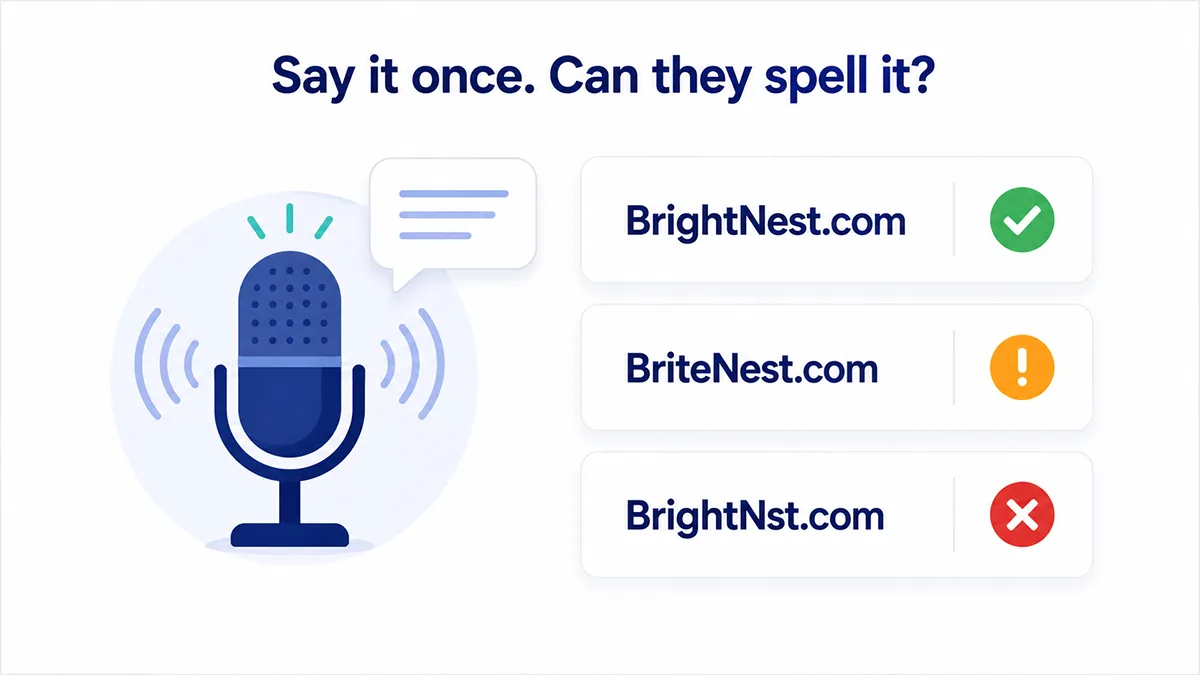
The radio test asks a simple question: if someone hears the domain once — in a podcast, a phone call, a conversation — can they spell it correctly without asking? Names fail the test through multiple possible spellings, silent letters, unclear word boundaries, awkward consonant clusters, confusing plurals, and homophones.
Compare the hypothetical trio BrightNest.com, BriteNest.com, and BrightNst.com. The first is unambiguous. The second can work as a deliberate brand choice but will spend its life being spelled out loud. The third is a typo wearing a suit. Run the test yourself: say the name aloud to a few people who haven’t seen it, ask them to type it, and note who needs help. It isn’t scientific valuation — it’s a clarity check that catches expensive problems early.
6. Spelling Clarity, Hyphens, Numbers and Confusion
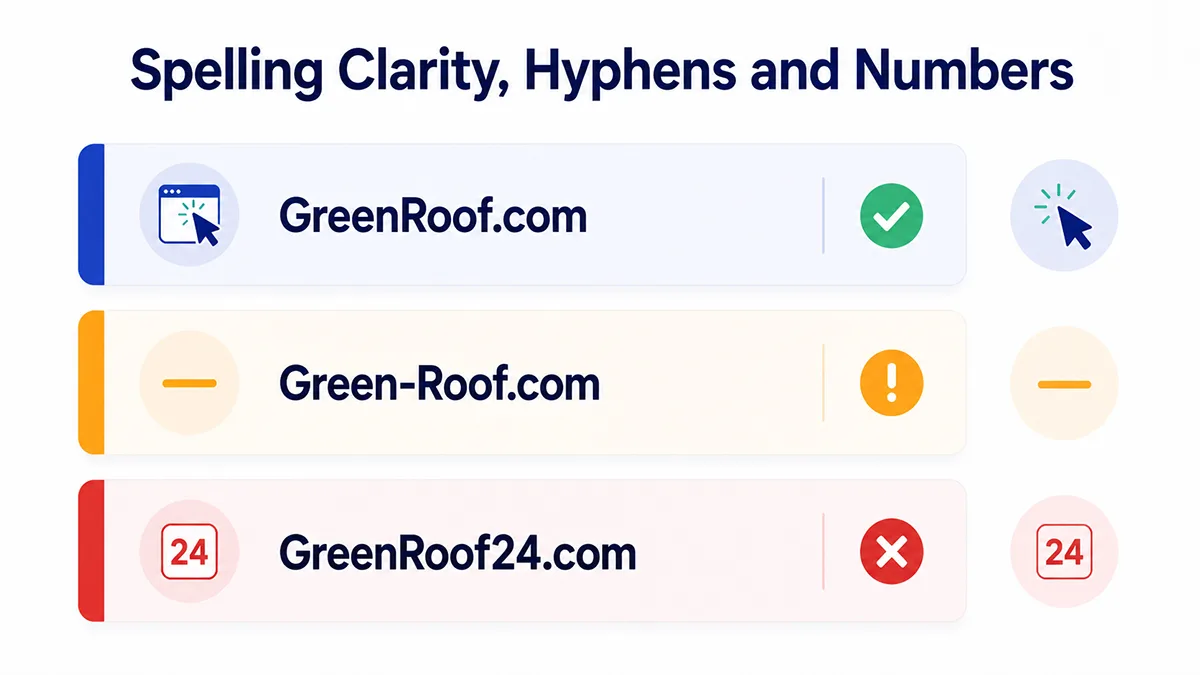
Buyers routinely discount names with hyphens, unnecessary numbers, repeated letters, ambiguous abbreviations, easy-to-miss plurals, or common misspellings. The reasons are practical: more typing mistakes, more verbal explanation, traffic and email leaking to the cleaner version, harder branding, and lower trust for some business uses. Hypothetically, GreenRoof.com is simply easier to own than Green-Roof.com or GreenRoof24.com.
These are deductions, not disqualifiers. A number that’s part of a known concept, a market where numeric terms are expected, or a hyphen that improves clarity in a particular language can all be legitimate. The question is how much ongoing explanation the name demands.
Practical Test
How often would the owner need to explain the spelling?
7. Age, Clean History and Legal Safety
Domain Age
Age provides context, not value. An older registration becomes attractive when it comes with continuous legitimate use, recognizable history, verified direct traffic, clean backlinks (links from other websites), or existing brand awareness. Age by itself doesn’t improve search rankings and doesn’t raise the price.
Previous Use
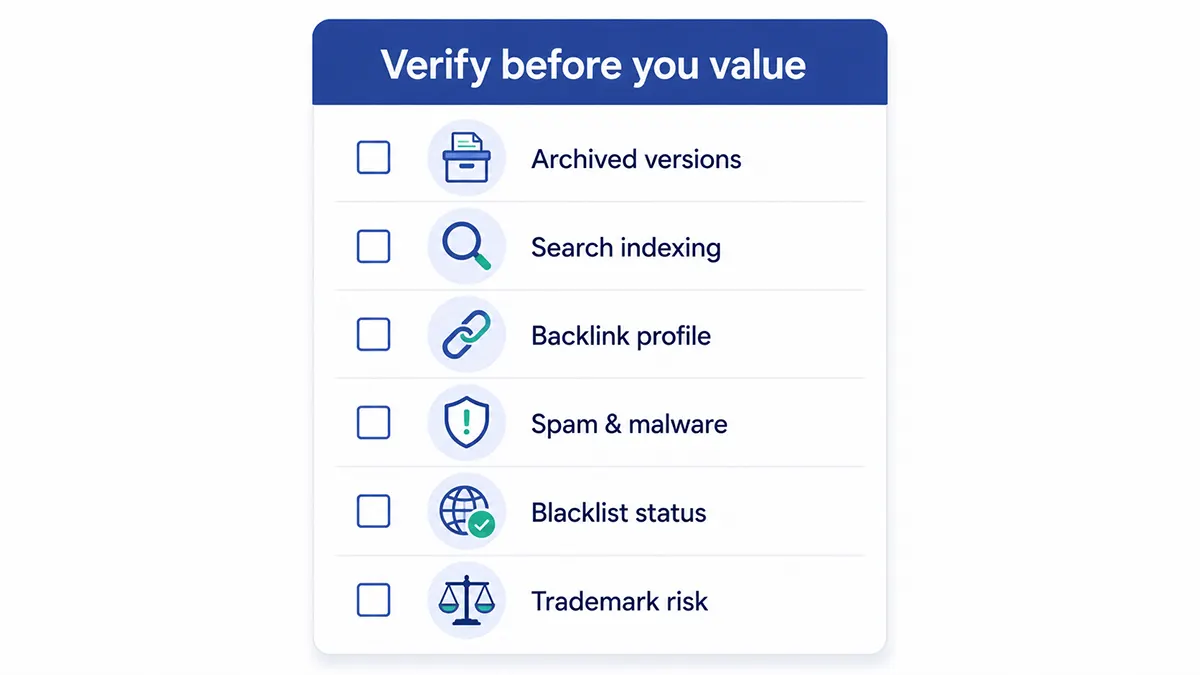
Before valuing any aged domain, check its past: archived versions of the site, search-engine indexing, the backlink profile, spam or malware history, email blacklist status, and whether it bounced between industries, languages, or redirects. A domain previously used for spam or deceptive content can carry problems forward — though not every expired or repurposed domain is damaged goods. Verify; don’t assume in either direction.
Trademark and Legal Safety
Registering a domain grants no trademark rights. A name loses practical value when it copies or closely resembles an existing brand, was acquired mainly to sell to a trademark owner, or can only be used by confusing customers. The Uniform Domain-Name Dispute-Resolution Policy (UDRP) gives certain trademark owners a process to challenge abusive registrations. This isn’t legal advice — for a high-value acquisition or an uncertain case, get professional trademark advice.
Practical Test
Can a legitimate buyer use this name without inheriting obvious reputation or legal problems?
8. Commercial Relevance and the Buyer Pool
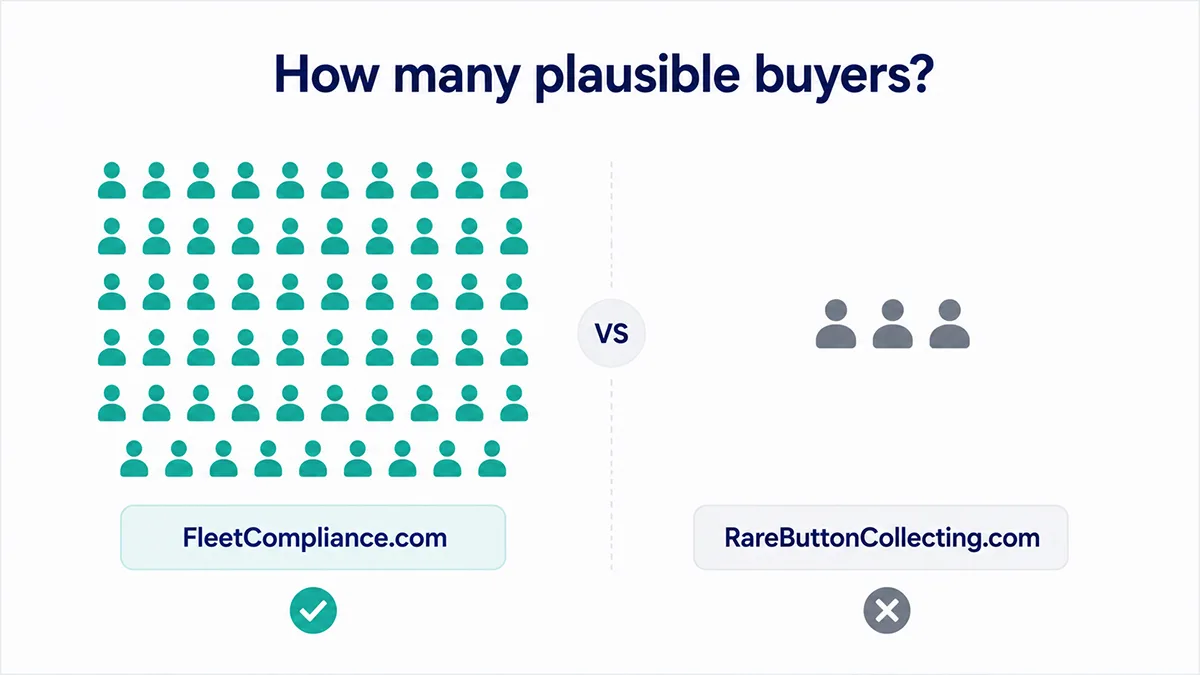
A domain needs plausible buyers — and the size and quality of that pool drives price more than most owners realize. More buyers create competition. Businesses with higher customer values can justify bigger naming budgets. A name tied to an active commercial problem is easier to defend internally than a nice-to-have. Compare hypothetical categories: FleetCompliance.com speaks to a broad pool of companies with real budgets, while RareButtonCollecting.com serves a passionate but tiny audience. No dollar figures needed — the difference in buyer pools is the point.
Watch buyer concentration, too. One obvious buyer creates dependency, not value — and a domain whose only exit is pressuring a trademark owner isn’t an asset, it’s a liability. Several plausible, independent buyers make a healthier market.
Practical Test
Who are the five most plausible buyers, and why would each one prefer this name over a cheaper alternative?
9. Comparable Completed Sales
Comparable sales — comps — are completed transactions involving domains with similar characteristics: extension, length, word count, industry, keyword type, brandability, language, buyer use, venue, and whether a website came with the name. Completed sales beat every alternative evidence source: asking prices (which anyone can set), unsold listings, automated appraisals, the registration fee you paid, and your own attachment to the name.
Comps have limits. No two domains are identical, buyer motivation varies, private sales never appear in public databases, some reported deals included websites or businesses, and a famous headline sale is rarely comparable to an ordinary name. The method still works: to evaluate a hypothetical BlueOakFinance.com, look for completed sales of two-word .com names with finance-related terms, similar length, and similar brandability — several of them, not one dramatic outlier.
Practical Test
Can you find several genuinely similar completed sales — not merely high asking prices?
How the Nine Domain Value Factors Work Together
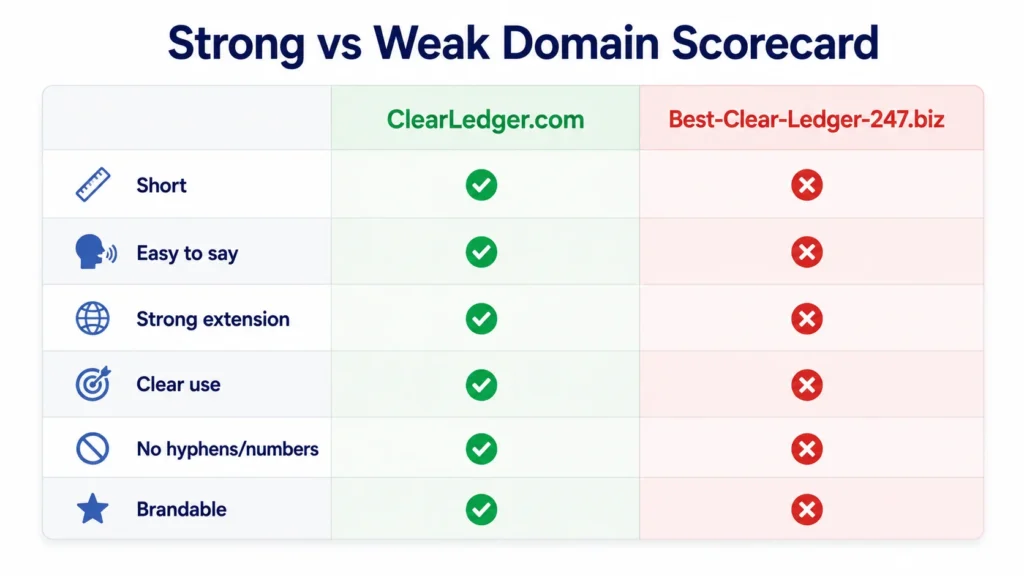
Value compounds when strengths stack in one name. A hypothetical ClearLedger.com combines two familiar words, clear pronunciation, a .com extension, an obvious accounting use, multiple plausible buyers, no hyphen or number, and genuine brand potential. Its hypothetical opposite, Best-Clear-Ledger-247.biz, stacks weaknesses instead: longer, hyphenated, numbered, harder to say, and wearing an extension few accounting buyers expect.
The harder lesson: one strong factor rarely cancels several serious weaknesses. A short domain can still be meaningless. A good keyword can still carry trademark risk. An old domain can still have a toxic history, a .com can still have no buyer, and a clever brandable can still be unspellable. Judge the whole name, not your favorite feature of it.
Domain Value Checklist
Run any domain through these questions before pricing it:
- Is the domain easy to remember after one viewing?
- Is it easy to say and spell?
- Is it reasonably short for its intended use?
- Does the extension fit the buyer and market?
- Does the name communicate a useful product, service, or brand?
- Are there several plausible buyers, and can they afford a meaningful acquisition?
- Does it avoid unnecessary hyphens, numbers, and spelling confusion?
- Is the domain’s previous use clean and relevant?
- Are traffic and backlinks verified rather than assumed?
- Is there an obvious trademark or UDRP risk?
- Are there genuinely comparable completed sales?
- Is the expected price realistic compared with the buyer’s alternatives?
- Can a buyer easily contact the owner?
Resist turning this into arithmetic. Twelve checkmarks don’t equal a five-figure domain, and failing one item doesn’t make a name worthless. The checklist’s job is to reveal strengths, weaknesses, and the research you haven’t done yet.
What Automated Domain Appraisals Can and Cannot Do
Automated appraisal tools estimate value from measurable signals: length, extension, keyword data, reported comparable sales, historical listings, and language patterns. Used properly, they give you an initial reference point, a consistent way to compare several domains, and a lead on possible comps.
Their blind spots are exactly the things that decide real sales. No tool knows a specific buyer’s motivation, catches every trademark risk, understands an unusual brand, or sees the private sales missing from public data — which is why different tools produce wildly different numbers for the same name. An appraisal is not an offer, and a high estimate doesn’t mean anyone will pay it. The strongest evidence of current value is a credible buyer willing and able to complete a transaction.
Turning Potential Value Into a Buyer Conversation
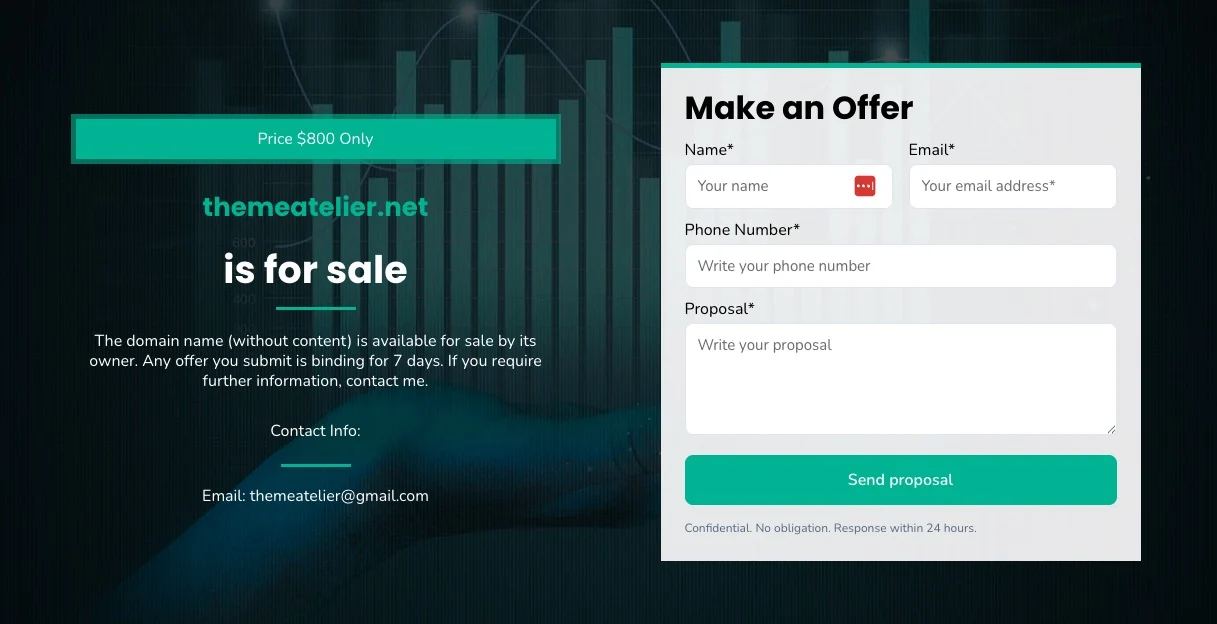
Everything above matters only if an interested buyer can discover the domain is available and reach you. A valuable name that resolves to a server error, an abandoned project, a blank page, or a parked page with no inquiry path is invisible inventory. Give it a clear sale destination: a marketplace lander, a portfolio page, a Buy Now checkout, or a self-hosted sale page with a Make an Offer form.
Domain For Sale is the WordPress plugin we build for creating self-hosted domain-sale pages, offer forms, and inquiry workflows. The free version covers the landing page, pricing display, and buyer inquiries; Pro adds advanced options such as Escrow.com purchase forms. It won’t appraise your domain or create demand — it makes sure the demand that exists can find you. [INTERNAL LINK: How to Set Up a Domain For Sale Landing Page in WordPress] [INTERNAL LINK: How to Add a Make an Offer Form to Your Domain Landing Page]
Frequently Asked Questions
How Do I Know if My Domain Is Valuable?
Work through the nine factors: usefulness to real buyers, extension fit, length, memorability, commercial relevance, the size of the buyer pool, clean history, legal risk, and comparable completed sales. If the name passes most of those checks — and you can actually name several businesses that would want it — it may have resale value. Remember that a single credible offer from a real buyer is stronger evidence than any automated estimate.
Are Old Domain Names Worth More?
Not automatically. Age adds value only when it comes with something: clean history, legitimate recognition, verified traffic, quality backlinks, or continuous relevant use. An old domain that spent years hosting spam or bouncing between owners may be less attractive than a fresh registration of a better name. Age is also not a direct Google ranking advantage — search engines evaluate the website and its content, not the registration date.
Which Domain Extensions Are Most Valuable?
.com attracts the broadest commercial resale interest thanks to familiarity and liquidity, which is why buyers often want the .com version of their brand. But the best extension depends on the buyer’s market, geography, industry, and audience expectations — a strong country-code extension like .de or .co.uk can beat .com for a local business, and a specialized ending can fit a specific use. No extension determines value or search rankings by itself.
How Can I Get My Domain Appraised?
Layer your evidence. Start with completed comparable sales, then identify plausible end users and what alternatives they’d consider. Inspect the domain’s history and legal risk. Use automated tools only as rough reference points, and consider a professional broker or appraiser for a genuinely high-value name — their opinions aren’t guarantees either. Finally, test the market: a realistic price or offer page tells you more than another estimate.
Do Keywords in a Domain Improve Its Value?
They can, when the words describe something businesses pay for — a service, a product category, a customer problem. A commercially clear name is easier for buyers to justify. But keywords alone don’t guarantee rankings, search volume isn’t the same as buyer demand, and a long exact-match phrase can be harder to brand than a distinctive invented name. Plenty of strong brandables outsell generic keyword strings; clarity for buyers is the real prize.
Conclusion
So, what makes a domain valuable? A name that credible buyers can use, remember, and communicate; an extension that fits the market; genuine commercial or brand potential; several plausible buyers rather than one; a clean history; low legal risk; and support from comparable completed sales. No checklist guarantees a sale or an exact price — the framework’s job is to tell you which of those ingredients your domain actually has, and which parts of your valuation are still wishful thinking.
If the domain in your account passes the tests above, do the one thing that costs nothing: make sure an interested buyer can reach you. Put a clear sale page or marketplace lander on it — the free Domain For Sale plugin handles the self-hosted route — and let the market tell you what the name is really worth. For the commission side of that decision, see our guide on how to sell a domain without paying commission.