


If you’re comparing Sedo vs Afternic vs Dan.com, there’s one thing to know before anything else: one of these three marketplaces no longer exists. GoDaddy shut down Dan.com on June 27, 2025, after migrating seller accounts to Afternic. Visit Dan.com today and you’ll simply be redirected to Afternic.
Quick answer: in 2026, the real choice is between Sedo and Afternic — or selling directly from your own website. Afternic suits sellers who want maximum exposure through registrar networks and automated transfers. Sedo suits sellers who want international reach, auctions, and a major marketplace outside the GoDaddy ecosystem. Many experienced investors use a marketplace and their own landing pages together.
This guide compares both platforms in detail and looks at when running your own domain-for-sale pages is the smarter long-term play.
Key Takeaways
- Dan.com was shut down by GoDaddy on June 27, 2025. Its listings, lease-to-own model, and transfer technology now live inside Afternic.
- Sedo and Afternic are the two major general-purpose marketplaces left. Neither is universally better — the right pick depends on your portfolio, buyers, and goals.
- Commissions and policies change often. Always confirm current rates on the official Sedo and Afternic pricing pages before listing.
- The Dan.com shutdown is a platform-risk lesson: many experienced sellers now pair marketplace listings with their own WordPress landing pages to capture direct buyers.
Table of Contents
First, the Big Change: Dan.com Is Gone
Dan.com stopped operating on June 27, 2025. GoDaddy, which reportedly paid north of $71 million to acquire the Amsterdam-based platform in 2022, announced the retirement in late 2024 and gave sellers a migration window to move their accounts and listings to Afternic. The timeline was covered in detail by Domain Name Wire and DomainInvesting.com.
If you’re a former Dan.com seller, your practical to-do list is short: confirm your listings actually made it into your Afternic account, check your payout details are current, and review your asking prices — then decide whether Afternic alone gives you the coverage you want. We’ll come back to what Dan.com’s closure teaches every seller a little later.
Why Does Choosing the Right Marketplace Matter?
Because where you list a domain directly affects three things: how many qualified buyers see it, how much of the sale price you keep, and how smooth the transfer feels for the buyer. Get those wrong and even a great domain can sit unsold for years.
Many first-time sellers assume that listing a domain on a large marketplace automatically leads to a sale. It doesn’t. Pricing, demand, and presentation matter just as much as exposure. A marketplace puts your domain in front of buyers — it doesn’t create demand for a name nobody wants at a price nobody will pay.
There’s also the cost side. We’ve seen plenty of domain owners become frustrated after a sale closes and the commission takes a noticeable bite out of their final profit. That’s not a reason to avoid marketplaces — but it is a reason to understand the fee structure before you list, not after you sell.
Quick Comparison: Sedo vs Afternic vs Dan.com at a Glance
Here’s the short version. Dan.com stays in the table for context, since plenty of sellers still search for it, but it’s no longer an option you can choose.
| Sedo | Afternic | Dan.com | |
|---|---|---|---|
| Status in 2026 | Active | Active | Shut down June 27, 2025; redirects to Afternic |
| Founded | 2001 (Cologne, Germany) | 1999 (US) | 2014 as Undeveloped, rebranded 2019 |
| Ownership | Independent of GoDaddy | GoDaddy | Was GoDaddy (acquired 2022) |
| Best known for | Global reach, auctions, brokerage, parking | Registrar distribution, Fast Transfer, lease-to-own | Clean landing pages, lease-to-own |
| Strongest fit | International sellers, auction-style sales | Sellers who want checkout-level exposure at major registrars | N/A — its best features now live in Afternic |
Sedo Overview: The Independent Veteran
Sedo has been operating since 2001, making it one of the oldest domain marketplaces still running. As of 2026, the Cologne-based platform advertises more than 24 million domain listings and customers in over 150 countries, according to Sedo’s own marketplace pages. Its multilingual platform gives it a particularly strong footprint with European and international buyers.
What do you actually get as a seller? Sedo covers most selling formats in one place:
- Fixed-price and make-offer listings for standard sales
- Auctions, including the curated GreatDomains events for higher-grade names
- Brokerage services for premium domains where negotiation matters
- Domain parking, so a name can earn something while it waits for a buyer
- SedoMLS, a promotion network that pushes listings out to 700+ partner registrars
Sedo’s independence matters more than it used to. After GoDaddy folded Dan.com into Afternic, Sedo became the main large marketplace outside the GoDaddy ecosystem. For sellers who’d rather not keep their entire portfolio inside one company’s platform, that’s a genuine consideration — not just a talking point.
Afternic Overview: GoDaddy’s Distribution Machine
Afternic launched in 1999 and has been owned by GoDaddy since 2013. Its defining strength is distribution: Afternic states that domains on its Fast Transfer network appear in some 85 million searches by prospective buyers, surfacing directly in results at partner registrars at the moment someone is trying to register a name.
Think about what that means in practice. A small business owner searches for a name at their registrar, sees it’s taken, and gets your domain offered as a premium alternative — inside a checkout flow they already trust. That’s a very different kind of exposure than hoping a buyer browses a marketplace directly.
Two features deserve special mention:
- Fast Transfer automates the handover for eligible domains, shortening the gap between “sold” and “paid” and removing the manual steps that make some buyers nervous.
- Lease to Own — inherited from Dan.com — lets buyers pay in installments while the domain stays locked until the final payment. Afternic reports that lease-to-own transactions carry a 35% higher average sale price than Buy It Now sales, per the Afternic blog.
If you sold on Dan.com specifically for its installment model, this is where that model lives now.
What Dan.com’s Shutdown Teaches Every Domain Seller
Dan.com — originally launched as Undeveloped in 2014 and rebranded in 2019 — was widely liked for things the rest of the industry then copied: clean, conversion-focused landing pages, transparent buyer communication, installment deals, and unusually fast automated transfers. It was many investors’ favorite platform. And it still disappeared.
That’s the lesson, and it goes beyond nostalgia. A marketplace is someone else’s platform. It can be acquired, merged, repriced, or shut down — and when that happens, your listings, your landing pages, and sometimes your buyer conversations move on someone else’s schedule. Sellers who also maintained their own landing pages felt the disruption far less, because the address buyers actually visit — the domain itself — never stopped working for them.
Diversification isn’t paranoia here. It’s how experienced sellers structure things: marketplace listings for reach, plus a direct channel they fully control.
How Do Sedo and Afternic Compare on Reach and Buyer Exposure?
Both platforms reach buyers in two ways: people browsing the marketplace itself, and people encountering your domain through partner networks. The difference is emphasis.
- Afternic leans on registrar distribution. Its Fast Transfer network puts premium listings in front of buyers during domain searches at major registrars — high-intent moments where someone is actively trying to buy a name.
- Sedo combines its own marketplace traffic with the SedoMLS network of 700+ partners, and its multilingual platform reaches international and European buyers that US-centric channels can miss.
Here’s the part many comparison guides skip: for a lot of domains, the highest-intent buyer never browses any marketplace. They type the domain into their browser to see what’s there. If that visit lands on a generic parking page — or worse, an error — you’ve lost your best lead. Whatever marketplace you choose, make sure the domain itself shows visitors how to make an offer.
Commissions and Fees: What Should You Actually Expect?
Both Sedo and Afternic charge a commission — a percentage of the sale price, deducted before you’re paid. The exact rate typically depends on the listing type and whether the sale came through the marketplace directly or through a partner registrar. Partner-network sales often carry a higher rate than direct marketplace sales, because the partner takes a share too.
We’re deliberately not quoting exact percentages here, and that’s not evasiveness — it’s accuracy. Marketplace fees have changed several times over the past few years, and any specific number in a blog post can be outdated within months. Before you list, check the current rates directly:
- Sedo’s official pricing information at sedo.com
- Afternic’s pricing and fees page at afternic.com
💡 Expert tip: Price backwards from your net figure. Decide what you want to walk away with, then add the commission on top. Sellers who price at their target and subtract fees later are the ones who end up disappointed at payout time.
Landing Pages, Transfers, Trust, and Ease of Use
Landing page experience
Dan.com set the modern standard here, and its influence is visible everywhere. Afternic’s landers within the GoDaddy ecosystem and Sedo’s sales pages both give buyers a clear path to purchase or make an offer. What they don’t give you is much control. Layout, branding, and messaging are largely fixed — your domain looks like every other domain on the platform.
Transfer and payout process
Afternic offers two paths: automated Fast Transfer for eligible domains and a manual Standard Transfer for the rest. Sedo’s transfer service guides both parties through the handover on its platform. In both cases the marketplace holds the buyer’s payment until the domain has changed hands, then pays you out — which protects both sides. Where your domains are registered genuinely affects how smooth this feels, so check registrar compatibility before listing.
Trust and reputation
Both platforms have decades of history and established processes for holding funds during a sale. Buyers recognize them, and that matters — an unknown buyer is far more willing to send five figures through a familiar marketplace than to a stranger’s payment link. If you sell independently, you can get equivalent protection by closing through a neutral escrow service such as Escrow.com.
Ease of use
If your domains already sit at GoDaddy or a partner registrar, Afternic is close to frictionless — listing can take minutes and transfers are largely hands-off. Sedo’s dashboard covers more selling formats, which brings a slightly steeper learning curve but more flexibility once you know it. Neither platform is difficult for a motivated beginner.
Pros and Cons: Sedo vs Afternic
| Platform | Pros | Cons |
|---|---|---|
| Sedo | Strong international and European reach; auctions and brokerage under one roof; parking income while you wait; independent of GoDaddy | Interface feels dated in places; less checkout-level placement than Afternic’s registrar network for US buyers |
| Afternic | Registrar distribution puts domains in front of buyers at the moment of search; Fast Transfer automation; lease-to-own inherited from Dan.com; simple if you already use GoDaddy | Deeply tied to one company’s ecosystem; partner-network sales can carry higher commission; little control over how your domain is presented |
| Dan.com | — (no longer available) | Shut down June 27, 2025; its landing pages, lease-to-own, and transfer tech now live inside Afternic |
Which Marketplace Is Best for Beginners?
For most beginners, Afternic is the path of least resistance — especially if your domains are already registered with GoDaddy or a partner registrar. The distribution network does the marketing work for you, and Fast Transfer removes most of the scary parts of handing over a domain.
Beginners usually value two things above everything else: simplicity and exposure. Both platforms deliver those reasonably well, so don’t agonize over the choice. Your first sale will depend far more on realistic pricing than on which marketplace hosted the listing. An honest look at comparable sales — resources like NameBio help here — will do more for you than any platform switch.
Which Is Best for Experienced Investors?
Experienced investors tend to stop asking “which marketplace?” and start asking “which mix?” In practice, that usually means listing across multiple marketplaces where terms allow it, while also maintaining their own landing pages to capture direct, commission-free buyers.
The priorities shift with experience, too. Beginners care about simplicity; seasoned sellers care about commissions, branding, buyer ownership, and flexibility. When you’re moving multiple domains a year, a commission percentage isn’t an abstract number — it’s a measurable cost you can weigh against running your own sales channel.
Can You Sell Domains Without a Marketplace?
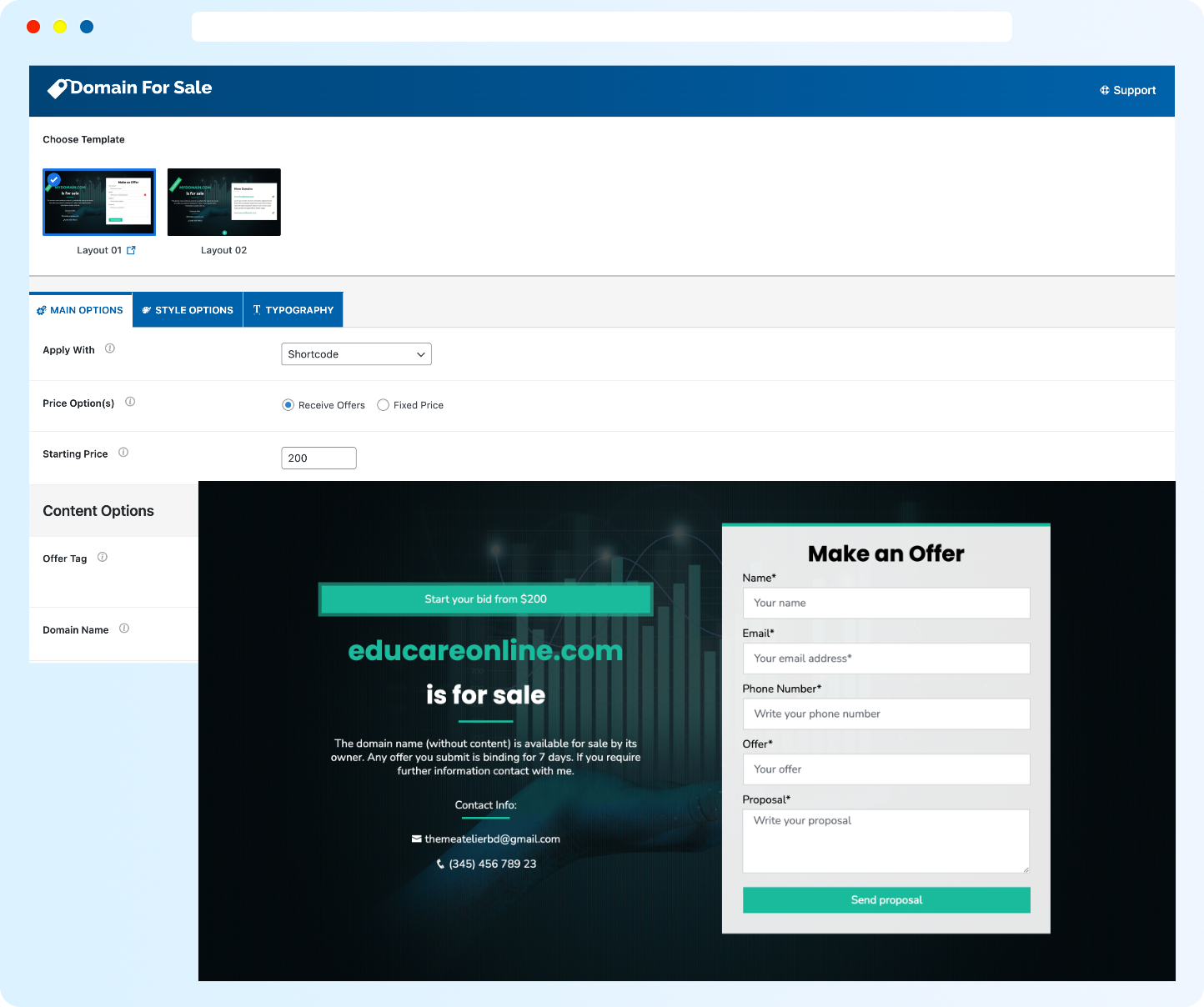
Yes — and more sellers do it than you might think. Direct selling means the domain itself becomes the storefront: a visitor types in the name, lands on a professional “this domain is for sale” page, and contacts you directly. No commission, no middleman between you and the buyer, and full control over how the domain is presented.
If you use WordPress, you don’t need to build this from scratch. The free Domain For Sale plugin creates attractive, conversion-focused landing pages for domains you want to sell — with the essentials covered: a clear for-sale message, an inquiry form so buyers can reach you, and a professional design that signals the domain is genuinely available. The Pro version adds advanced options for sellers managing larger portfolios or needing extra functionality.
To be clear about the trade-offs: your own landing page won’t replicate Afternic’s registrar distribution or Sedo’s international marketplace traffic. What it does is capture the buyers those channels can’t — the ones who type your domain directly into a browser — and let you keep the full sale price when they buy. That’s why many experienced sellers treat their own landing pages as a complement to marketplace listings, not a replacement.
Guide to creating a domain-for-sale landing page in WordPress
💡 Expert tip: Dual-channel selling is easy to set up. Point the domain at your WordPress landing page for direct visitors, and keep the same domain listed on a marketplace for network exposure. Just make sure your asking prices match in both places.
Final Recommendation: Which Should You Choose in 2026?
There’s no universally best domain marketplace — the right choice depends on your portfolio size, selling strategy, desired level of control, and who your likely buyers are. As a starting point:
- Choose Afternic if you want maximum point-of-search exposure through registrar networks, automated transfers, and lease-to-own options — especially if you already live in the GoDaddy ecosystem.
- Choose Sedo if international reach matters, you want auctions and brokerage in one place, or you’d prefer a major marketplace independent of GoDaddy.
- Former Dan.com sellers will find its signature features — installment purchases and fast transfers — inside Afternic today.
- Whichever you pick, verify current commissions and terms on the official sites before listing. Policies change, and this decision deserves current numbers.
And if you want complete control over branding, buyer inquiries, negotiations, and commissions, consider adding a direct channel alongside your marketplace listings. The free Domain For Sale WordPress plugin lets you turn any domain you own into its own branded sales page in a few minutes — so the buyers who come looking for you directly always find an open door.
Frequently Asked Questions
Is Dan.com still available in 2026?
No. GoDaddy, which acquired Dan.com in 2022, shut the platform down on June 27, 2025, after migrating seller accounts to Afternic. Dan.com now redirects to Afternic, and its best-known features — lease-to-own purchases and fast automated transfers — live on there.
Which domain marketplace is best for beginners?
Afternic is usually the simplest starting point, particularly if your domains are registered with GoDaddy or a partner registrar, because its distribution network markets listings automatically. Sedo is a strong alternative for auctions and international buyers. Realistic pricing matters more than the platform choice.
Can I list the same domain on Sedo and Afternic at the same time?
Often yes, but check each platform’s current terms first, since some listing types require exclusivity. If you do list in multiple places, keep asking prices identical everywhere and remove all other listings the moment a sale closes, so you never sell the same domain twice.
How do domain marketplace commissions work?
Marketplaces deduct a percentage of the final sale price before paying you out. Rates vary by platform, listing type, and whether the sale came through a partner registrar network, which usually costs more than a direct marketplace sale. Always confirm current rates on the official Sedo and Afternic websites.
Do I need a marketplace to sell a domain at all?
No. Many sellers close deals directly through a landing page on the domain itself, using an inquiry form to field offers and a neutral escrow service to handle payment safely. Tools like the free Domain For Sale WordPress plugin make setting up a professional sales page straightforward — no commission required.