

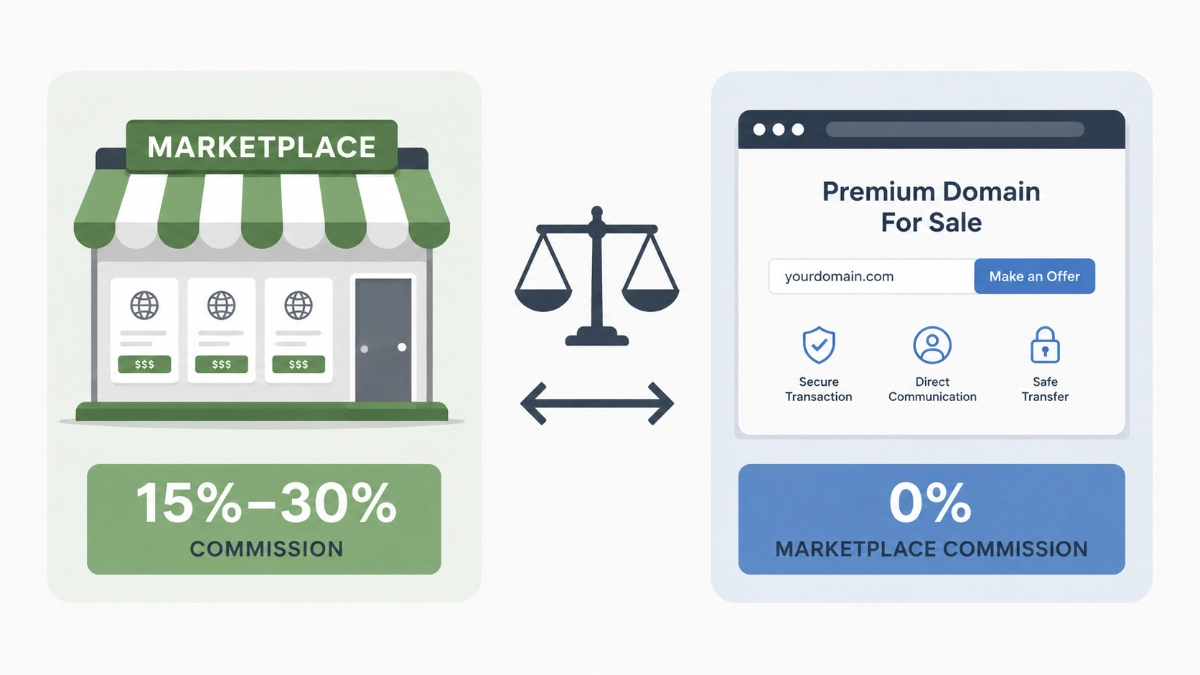

Here’s the verdict up front: Afternic buys distribution, while your own website protects margin and gives you control over direct inquiries. Afternic vs own website isn’t really an either/or question. For many portfolio owners, the strongest strategy is deciding which channel should handle each buyer and each domain. Afternic’s standard commission currently runs from 15% to 30% depending on Boost status and nameservers. A direct lead from your own page carries 0% marketplace commission, though escrow, payment, and hosting costs can remain.
Below, we run the payout numbers at $2,000, $5,000, and $20,000, and walk through the trade-off most comparisons skip: the nameserver decision that changes your Afternic rate. Neither channel is free of work or risk. The goal is knowing what each one actually costs. Rates verified against Afternic’s official pricing page on July 19, 2026.
Table of Contents
Key Takeaways
- Afternic’s main advantage is distribution: eligible listings can surface in search results at more than 100 partner registrars.
- Afternic’s standard commission is 15%, 20%, 25%, or 30%, depending on whether Boost is active and whether the domain uses qualifying GoDaddy aftermarket nameservers.
- A self-hosted landing page gives the seller ownership of type-in visitors and independently generated leads.
- Direct inquiries carry no marketplace commission, but escrow, payment, hosting, and transfer costs can remain.
- Pointing a domain at self-hosted nameservers may push an Afternic-generated sale into the higher non-approved-nameserver commission band.
- Most portfolios benefit from a hybrid: marketplace landers for low-traffic names, self-hosted pages for domains with type-in interest or direct demand.
Afternic vs Own Website at a Glance
Afternic’s standard commission runs 15% to 30% depending on Boost and nameservers, against 0% marketplace commission on a self-hosted direct lead. The table below breaks down every other trade-off behind those two numbers.
| Factor | Afternic | Self-hosted website |
|---|---|---|
| Buyer reach | Marketplace traffic plus partner network | Only visitors you attract or contact |
| Registrar distribution | Search results at 100+ partner registrars | None |
| Standard commission | Varies from 15% to 30% under the verified current standard structure | 0% marketplace commission on direct leads; separate closing and operating costs may apply |
| Type-in lead ownership | Marketplace lander captures the visit | You capture and own the inquiry |
| Branding | Platform-styled landers | Full control of design and message |
| Negotiation control | Platform flows; possible broker involvement | You negotiate directly |
| Fast Transfer | Available for eligible domains | Not applicable |
| Transaction support | Checkout, payment collection, transfer coordination | You arrange escrow or checkout yourself |
| Setup effort | List and point nameservers | WordPress, hosting, plugin, DNS, email |
| Ongoing maintenance | Keep listings and prices current | Updates, security, backups, form testing |
| Nameserver effect | Qualifying nameservers reduce commission | Self-hosted DNS may raise the Afternic rate on marketplace sales |
| Best use case | Domains that need distribution to find a buyer | Domains with type-in traffic or seller-generated demand |
Afternic commissions, Boost settings, nameserver requirements, minimum fees, transaction products, and distribution terms can change. These figures were checked against Afternic’s official pricing information on July 19, 2026. Verify the current terms before changing nameservers, listing a domain, or accepting a sale.
What Afternic Does Well
Any honest comparison starts here, because the commission pays for real infrastructure.
Registrar and Reseller Distribution
List a domain on Afternic and eligible listings can appear in search results at more than 100 partner registrars. That means a buyer can stumble onto your domain while registering a name somewhere else entirely. It’s demand you did nothing to create. No self-hosted page can replicate that reach.
Fast Transfer
Afternic’s Fast Transfer network (currently 90+ partners) automates fulfillment for eligible domains: the buyer pays, the domain transfers immediately, and the payout releases faster, with no manual push from you. Eligibility has limits, including supported TLDs (.com, .net, .org, .co, .io, .xyz, and others), a Buy Now price under $100,000, at least 60 days at the current registrar, no imminent expiration, and no transfer locks. One distinction worth keeping straight: Fast Transfer eligibility and nameserver-based commission eligibility are separate systems.
Buyer Trust and Transaction Infrastructure
A buyer who has never heard of you may hesitate to wire money to a stranger’s website. A GoDaddy-owned checkout with an established transaction process removes much of that hesitation. Trust isn’t universal: some buyers dislike marketplaces. But for unknown sellers, it’s a genuine conversion factor.
Sales and Negotiation Support
Afternic offers professional sales assistance and transaction coordination, and higher-value inquiries may get broker attention. Not every sale receives active brokerage, but when it happens, an experienced negotiator can be worth part of the commission.
Hands-Off Portfolio Selling
For a seller with hundreds of names who doesn’t want to answer inquiries, negotiate, invoice, and coordinate transfers, Afternic’s model is close to passive. The commission pays for far more than a landing page. That’s the fair way to frame it.
What Afternic Costs You
Commission on Every Marketplace Sale
There isn’t one Afternic rate: there are four standard scenarios, per the official pricing and fees page. Boost, enabled by default, charges 20% with qualifying GoDaddy aftermarket nameservers and 30% without. Opting down to Afternic Basic charges 15% with qualifying nameservers and 25% without, in exchange for reduced distribution exposure. Every standard sale carries a $15 minimum commission.
The Nameserver Decision
This is the trade-off most comparisons miss. Qualifying nameservers earn the discounted commission. But they point your domain at the marketplace’s lander, so every type-in visitor lands on Afternic’s page, not yours. Point the domain at your own hosting instead, and you control the page and collect direct inquiries, but the domain may still be listed in Afternic’s network, and a sale that arrives through Afternic may then bill at the higher non-approved-nameserver rate.
In plain terms: you’re trading a possible commission discount for ownership of your type-in traffic. That’s a genuine strategic choice with a real cost on either side, and the right answer differs by domain.
Less Branding and Lead Control
On a marketplace sale, Afternic owns the buyer journey — the lander, the checkout, the communication. You get the payout, but less direct control over the customer relationship, the presentation, and the negotiation than you’d have on your own page.
Dependence on Marketplace Terms
Commission structures, Boost defaults, nameserver rules, and distribution features have all changed before and can change again. Sellers must keep listings and prices current, and a completed marketplace sale generally can’t be cancelled because a better direct buyer appeared afterward. Read the current membership agreement rather than relying on how things worked last year.
Pricing Across Multiple Channels
Running two channels adds hygiene work: conflicting Buy Now prices confuse buyers, stale listings cause double sales, and a sold domain left active elsewhere is a dispute waiting to happen. And don’t try to reroute a marketplace-generated buyer to your own page to dodge an earned commission. The agreement you accepted covers that.
Real Numbers: What the Seller Actually Keeps
Let’s run the numbers. These are illustrative calculations using the verified current standard rates. The formula is simple: estimated proceeds = sale price − marketplace commission. For a direct sale, gross proceeds before closing costs = sale price − 0% marketplace commission. All rows exclude taxes, currency conversion, payout-provider fees, registrar costs, optional brokerage, Lease to Own, legal expenses, and escrow fees.
$2,000 Domain Sale
| Channel | Rate | Fee | Proceeds | Difference from 0% marketplace commission |
|---|---|---|---|---|
| Afternic Basic + qualifying nameservers | 15% | $300 | $1,700 | $300 |
| Afternic Boost + qualifying nameservers | 20% | $400 | $1,600 | $400 |
| Afternic Basic + non-qualifying nameservers | 25% | $500 | $1,500 | $500 |
| Afternic Boost + non-qualifying nameservers | 30% | $600 | $1,400 | $600 |
| Afternic Custom Checkout Link (Buy Now) | 5% | $100 | $1,900 | $100 |
| Direct self-hosted lead | 0% marketplace commission | $0 | $2,000 before closing costs | — |
The direct row excludes escrow, payment processing, hosting, plugin licensing, banking, tax, legal, and registrar costs. Call the gap “commission avoided before other expenses,” not profit.
$5,000 Domain Sale
| Channel | Rate | Fee | Proceeds | Difference from 0% marketplace commission |
|---|---|---|---|---|
| Afternic Basic + qualifying nameservers | 15% | $750 | $4,250 | $750 |
| Afternic Boost + qualifying nameservers | 20% | $1,000 | $4,000 | $1,000 |
| Afternic Basic + non-qualifying nameservers | 25% | $1,250 | $3,750 | $1,250 |
| Afternic Boost + non-qualifying nameservers | 30% | $1,500 | $3,500 | $1,500 |
| Afternic Custom Checkout Link (Buy Now) | 5% | $250 | $4,750 | $250 |
| Direct self-hosted lead | 0% marketplace commission | $0 | $5,000 before closing costs | — |
Same caveat: the direct row is gross, before escrow, payment, hosting, banking, tax, legal, and transfer expenses.
$20,000 Domain Sale
| Channel | Rate | Fee | Proceeds | Difference from 0% marketplace commission |
|---|---|---|---|---|
| Afternic Basic + qualifying nameservers | 15% | $3,000 | $17,000 | $3,000 |
| Afternic Boost + qualifying nameservers | 20% | $4,000 | $16,000 | $4,000 |
| Afternic Basic + non-qualifying nameservers | 25% | $5,000 | $15,000 | $5,000 |
| Afternic Boost + non-qualifying nameservers | 30% | $6,000 | $14,000 | $6,000 |
| Afternic Custom Checkout Link (Buy Now) | 5% | $1,000 | $19,000 | $1,000 |
| Direct self-hosted lead | 0% marketplace commission | $0 | $20,000 before closing costs | — |
At this level the nameserver decision alone is worth $2,000: the gap between Boost at 20% and Boost at 30%. Again, the direct row excludes escrow, payment, hosting, banking, tax, legal, and registrar-related costs.
The Portfolio-Level Impact
Scale it up. Ten $5,000 sales gross $50,000. At 20% commission, fees total $10,000; at 30%, $15,000. On direct leads, marketplace commission is $0, with variable closing expenses not included.
Now the mandatory caveat: this calculation does not assume you could independently generate the same ten buyers. Afternic’s distribution may be the reason some — or all — of those sales happened at all. Commission avoided on sales that never occur is worth exactly nothing.
What Selling Domains on Your Own Website Requires
You Must Generate or Capture the Buyer
Publishing a landing page generates zero traffic by itself. Direct buyers come from type-in visits, outbound prospecting, search, referrals, social profiles, existing audiences, and past inquiries. The page’s job is converting that interest into an inquiry you own — not creating interest from nothing.
You Handle the Negotiation
You respond promptly, qualify the inquiry, hold your floor price, negotiate professionally, keep written records, and watch for suspicious behavior. Some sellers enjoy this; others would happily pay 20% never to do it. Know which you are.
You Arrange the Transaction
Generating a lead and closing it securely are separate jobs. Reasonable closing methods include Escrow.com, an Afternic Custom Checkout Link, or another reputable domain transaction service matched to the deal’s size and risk. Never begin an irreversible transfer based on a payment screenshot. See how to accept domain payments securely with Escrow.com for the full setup.
You Complete the Domain Transfer
Unless your closing service coordinates it, you handle or authorize the registrar push or transfer yourself, after payment is secured.
You Maintain the Website
Hosting, WordPress and plugin updates, security, backups, email deliverability, form testing, analytics, and privacy handling are ongoing responsibilities. None are difficult individually, but a broken inquiry form that fails silently for a month is the most expensive maintenance lapse a direct seller can have.
Setting Up the Self-Hosted Option With Domain For Sale
The website part is the solvable part. The free Domain For Sale plugin builds professional domain-sale landing pages with fixed-price or offer-based presentation, buyer inquiry and offer forms, centralized offer management in WordPress, email notifications, customizable templates, portfolio listings, page-builder compatibility, and responsive layouts. Domain For Sale Pro adds Escrow.com purchase forms, private Escrow invitations, and additional layouts and management features for sellers who want them. Our step-by-step setup tutorial covers installation, pricing modes, and publishing in about five minutes.
Setup is quick once WordPress is installed, DNS is connected, hosting is active, and email delivery works. Those prerequisites are yours to have ready. Two honest limits: the plugin doesn’t generate buyers automatically, and it doesn’t hold funds or transfer domains. It handles the lead-capture infrastructure; the selling is still you. For the broader strategy, see our guide on how to sell a domain without paying commission.
Direct Buyer, Professional Checkout: A Middle Option
What if you found the buyer but want a professional close? Afternic’s Custom Checkout Link covers exactly that: you bring the negotiated deal, Afternic provides checkout and transaction assurance for a verified 5% on Buy Now transactions with a $15 minimum. Nameservers don’t affect this rate, Lease to Own uses a different 10% rate, and eligibility, value limits, and terms should be checked before relying on it.
The alternative is Escrow.com (through Domain For Sale Pro’s integration or directly), which offers neutral third-party escrow with its own fee schedule. Neither is universally superior: Custom Checkout Link trades a percentage for a familiar GoDaddy-backed process; Escrow.com offers independence from the marketplace ecosystem. Both beat an unprotected transfer by a wide margin.
The Both/And Strategy
Channel-Level Hybrid
A domain may remain listed in Afternic’s network while resolving to your own website, subject to current terms. The upside: Afternic’s reseller network can still produce buyers while your page captures type-in, outbound, and referral leads. The trade-offs are real, though: self-hosted nameservers may put Afternic sales in the higher commission band, prices must stay synchronized across channels, listings must come down immediately after a sale, and a marketplace-generated buyer can’t be treated as a direct lead to avoid an earned commission.
Portfolio-Level Hybrid
The stronger play for most sellers is segmentation. Use Afternic landers for low-type-in domains that depend on registrar distribution. Use self-hosted pages for domains with meaningful type-in traffic, active outbound campaigns, or branding value. Test Boost against Basic on your actual sell-through data rather than assumption. There’s no single configuration that fits every portfolio — which is exactly why the segmentation approach works.
A Decision Framework
| Situation | Better starting option | Reason |
|---|---|---|
| Domain receives little direct traffic | Afternic | Distribution has to create the demand |
| Domain has meaningful type-in traffic | Self-hosted page | Own the visitors already arriving |
| Seller wants a hands-off process | Afternic | Marketplace handles inquiries and closing |
| Seller runs outbound campaigns | Self-hosted page | Direct leads shouldn’t pay marketplace rates |
| Automatic Fast Transfer matters | Afternic | Instant fulfillment for eligible domains |
| Full branding and buyer communication | Self-hosted page | You control the page and the conversation |
| Seller already generated the buyer | Custom Checkout Link or Escrow.com | Pay a closing fee, not a distribution fee |
| Registrar-network exposure needed | Afternic | 100+ partner registrars can’t be replicated |
| Uncomfortable handling negotiations | Afternic | Sales support and structured flows |
| High-value domain with a known buyer | Escrow.com or Custom Checkout Link | Secure closing at a fraction of marketplace commission |
When Afternic Is Probably Worth the Fee
- Distribution generated the buyer — the commission paid for a sale you wouldn’t have made.
- The domain relies on registrar search exposure rather than type-in traffic.
- Fast Transfer’s instant fulfillment matters to you or your buyers.
- You want professional sales assistance instead of managing inquiries personally.
- Convenience across a large portfolio is worth more to you than per-sale margin.
When Your Own Website Makes More Sense
- The domain receives type-in visitors you’d otherwise hand to a marketplace lander.
- You’re conducting outbound or have an existing audience — you generated the lead.
- Branding and direct buyer communication matter for the name.
- The commission difference materially affects the deal’s economics.
- You’re comfortable negotiating and arranging a secure closing process yourself.
Frequently Asked Questions
What commission does Afternic charge?
Under the current standard structure, Afternic Boost (enabled by default) charges 20% with qualifying GoDaddy aftermarket nameservers and 30% without. Opting down to Afternic Basic charges 15% and 25% respectively, with reduced distribution exposure. A $15 minimum commission applies to standard sales. Because rates, Boost settings, and nameserver rules change, check Afternic’s official pricing page before listing or accepting an offer.
Is it better to sell domains on Afternic or my own website?
It depends on who generates the buyer. Afternic’s distribution across 100+ partner registrars can produce buyers you’d never reach, and its checkout and Fast Transfer reduce your workload — that’s what the 15%–30% commission buys. A self-hosted page wins for domains with type-in traffic or seller-generated demand, where paying a distribution fee on a direct lead makes little sense. Many portfolios use both, segmented by domain.
Can I list a domain on Afternic and my own website?
Often yes, subject to Afternic’s current terms: a domain can remain in the network while resolving to your own page. But weigh the consequences: self-hosted nameservers may put Afternic sales in the higher commission band, prices must match across channels, and a sold domain must come off every other channel immediately. Read the current membership agreement; this isn’t legal advice, and terms change.
How do I sell a domain from my own website?
The process: connect the domain to WordPress, install a domain-sale landing-page plugin such as Domain For Sale, add a price or offer form, capture the buyer’s inquiry, agree on terms, close through a secure transaction service like Escrow.com or an Afternic Custom Checkout Link, and transfer the domain only after payment is secured. The page handles lead capture; negotiation and safe closing remain your job.
Does selling on my own website mean I pay no fees?
No — it means 0% marketplace commission on a directly generated lead, which is different. Hosting, escrow or checkout services, payment processing, banking, legal, tax, plugin licensing, and registrar transfer costs may all still apply. On mid-size and larger sales those costs are usually far below a 15%–30% commission, but they aren’t zero, and treating the full sale price as profit is a bookkeeping mistake.
Can I use Afternic checkout for a buyer I found myself?
Yes, through Afternic’s Custom Checkout Link. You negotiate the price independently, then send the buyer a GoDaddy-hosted checkout link — currently 5% for Buy Now transactions with a $15 minimum, and 10% for qualifying Lease to Own deals. Nameservers don’t affect this rate because it’s a closing fee, not a distribution fee. Verify current eligibility, price limits, and terms before promising a buyer this route.
The Verdict: Afternic or Your Own Website?
Comparing Afternic versus your own domain-sale website comes down to buyer origin. Afternic wins on distribution, transaction convenience, and hands-off selling — and for buyers its network creates, the commission is the cost of a sale that might not otherwise exist. Your own website wins on branding, direct relationships, and margin for buyers you generate. The nameserver-based pricing means running both channels carries a real trade-off, not a free lunch, so calculate each sale’s cost by where the buyer came from.
The practical starting point: install the free Domain For Sale plugin on the domains where direct interest is plausible, and decide per deal whether to close through Escrow.com, Afternic Custom Checkout, or another appropriate service. It builds the direct channel’s infrastructure. It doesn’t replace Afternic’s distribution, and it doesn’t need to. For the wider marketplace landscape, our Sedo vs Afternic vs Dan.com comparison covers how the platforms differ beyond fees.