

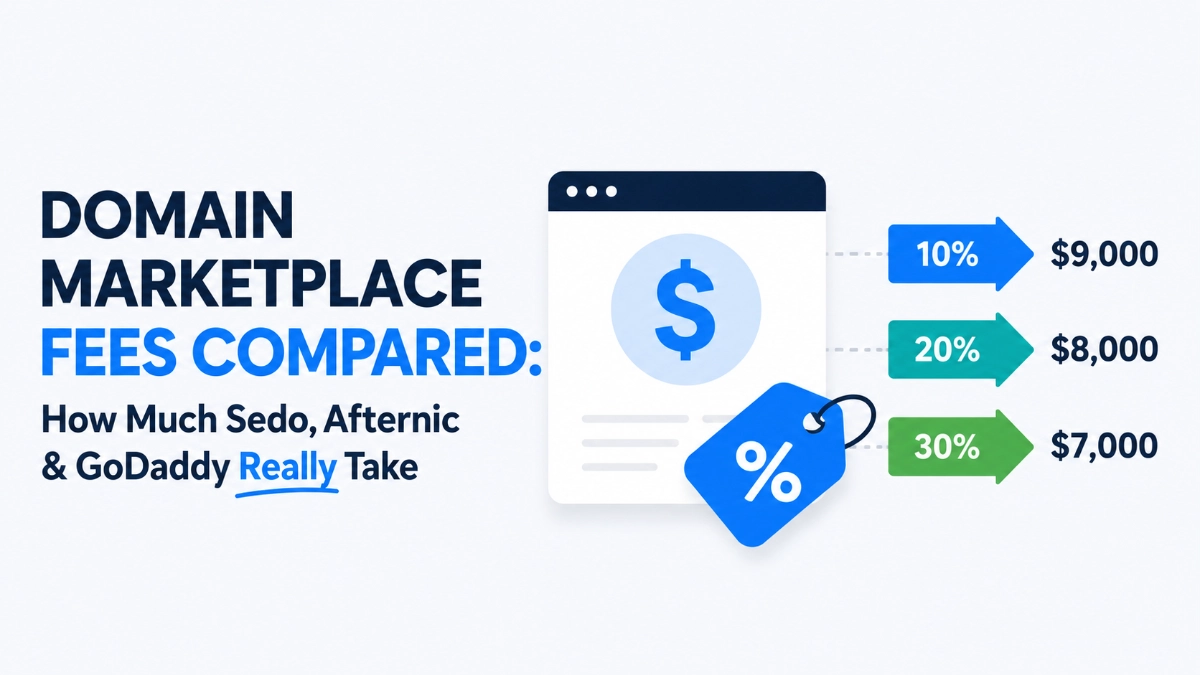

Picture a common scenario: a domain sells for $10,000, and the payout that arrives is $7,000. Nothing went wrong. The seller remembered a 15% commission and overlooked a nameserver rule, an enabled-by-default upgrade, or the channel that produced the buyer. Domain marketplace fees aren’t one number — they’re a set of conditions, and the headline price and your net payout are different figures.
This comparison covers what Sedo, Afternic, and GoDaddy charge on a standard one-time sale, with payout math at $2,000 and $10,000, plus the self-hosted alternative: generating leads from your own landing page and closing each deal separately. One clarification up front — GoDaddy’s List for Sale runs on Afternic’s commission system, not a separate fee schedule. Rates change, so check the current terms before you list or accept an offer.
Table of Contents
Key Takeaways
- Sedo’s commission depends on the sales channel: 10% for qualifying Buy Now sales on Sedo parking or a Sedo sales lander, 15% for other direct marketplace sales and auctions, and 20% through the SedoMLS partner network.
- Afternic’s commission depends on whether the domain uses qualifying GoDaddy aftermarket nameservers and whether the Afternic Boost plan is active.
- Afternic Boost is enabled by default and adds five percentage points to the base rate; sellers can opt out by downgrading to Afternic Basic.
- GoDaddy List for Sale is powered by Afternic, so sellers pay Afternic’s commission structure — there is no separate GoDaddy marketplace percentage.
- Afternic’s 5% Custom Checkout Link closes an externally negotiated sale and shouldn’t be compared directly with full marketplace-distribution commissions.
- A self-hosted domain-for-sale landing page charges 0% marketplace commission on the leads it generates, but escrow, payment, hosting, and transfer costs may still apply.
Domain Marketplace Fees at a Glance
Here’s the full picture. Each row is a distinct sales channel with its own rules — the caveat column matters as much as the percentage.
| Platform or channel | Standard fee | Main requirement | What the seller receives | Important caveat |
|---|---|---|---|---|
| Sedo Buy Now (parked or Sedo sales lander) | 10% | Buy Now price set, domain parked at Sedo or using a Sedo lander | 90% of sale price | Category-based minimum commissions apply |
| Sedo direct marketplace sale (Make Offer, auction) | 15% | Sale closes directly on the Sedo marketplace | 85% of sale price | Minimum commissions apply |
| SedoMLS network sale | 20% | Buyer comes through a SedoMLS partner registrar | 80% of sale price | Sellers don’t choose which channel produces the buyer |
| Sedo Direct Auction | 15% + $59 setup | Seller starts the auction voluntarily | 85% of sale price, minus the separate $59 charge | The $59 is paid to start the auction, not deducted as commission |
| Sedo external transfer service | 3% | Deal negotiated entirely outside Sedo | 97% of sale price | $60 minimum (category 1 TLDs) or $200 (category 2); marketplace commission can still apply if the lead began at Sedo |
| Afternic Boost, qualifying nameservers | 20% | Default plan + GoDaddy aftermarket nameservers | 80% of sale price | $15 minimum commission |
| Afternic Boost, other nameservers | 30% | Default plan, no qualifying nameservers | 70% of sale price | Nameserver status is checked under Afternic’s timing rules |
| Afternic Basic, qualifying nameservers | 15% | Opt out of Boost + GoDaddy aftermarket nameservers | 85% of sale price | Gives up Boost’s extra promotion |
| Afternic Basic, other nameservers | 25% | Opt out of Boost, no qualifying nameservers | 75% of sale price | $15 minimum commission |
| Afternic Custom Checkout Link | 5% (Buy Now) | Seller found and negotiated with the buyer independently | 95% of sale price | $15 minimum; Lease to Own uses a flat 10%; not a marketplace-distribution sale |
| GoDaddy List for Sale | Afternic’s rates | Listing started from a GoDaddy account | Depends on plan and nameservers | No separate GoDaddy commission — Afternic’s structure applies |
| Self-hosted Domain For Sale landing page | 0% marketplace commission | Seller generates and manages the lead | 100% of sale price before closing costs | Escrow, checkout, payment, hosting, and transfer costs may still apply |
Marketplace rates, minimum commissions, nameserver requirements, Boost settings, and optional-service charges can change. The figures in this article were checked against official pricing pages on July 19, 2026. Calculations exclude taxes, banking fees, currency effects, payout charges, and optional services unless stated. Confirm the current terms before listing a domain or accepting an offer.
Why the Percentage Alone Can Be Misleading
The lowest published rate is not automatically yours. What you keep depends on which marketplace generated the buyer, whether the domain used an approved lander or nameserver at the required moment, whether Boost was active, and whether the sale arrived through a partner network like SedoMLS. On top of that, paid auctions add a fixed setup charge, minimum commissions override the percentage on small sales, Lease to Own follows different rules, and taxes or payment fees can apply. The real question isn’t which rate is lowest — it’s which conditions your domain actually meets.
Sedo Fees Explained
Sedo publishes its rates in an official price list. The structure looks simple — 10%, 15%, or 20% — but each rate is tied to how the sale happens.
How Sedo’s 10% Commission Works
The 10% rate isn’t a general listing rate. It applies when a domain sells directly on the Sedo marketplace at a Buy Now price while parked with Sedo or pointed at a Sedo sales landing page. All three conditions matter — fixed price, qualifying lander or parking, direct Sedo sale. Merely listing a domain at Sedo doesn’t earn the discount.
When the 15% Rate Applies
The 15% rate is Sedo’s standard for other direct marketplace sales: Make Offer listings, marketplace auctions, and Buy Now sales that don’t meet the parking or lander conditions above.
SedoMLS Sales at 20%
SedoMLS distributes listings through partner registrars and platforms, so a buyer can purchase your domain while shopping somewhere else entirely. Sales arriving through that network pay 20% — the price of wider distribution and partner compensation, not an arbitrary surcharge.
Sedo’s Minimum Commissions
Sedo’s minimum commissions vary by domain category — currently $60 for category 1 TLDs and $200 for category 2. The rule: the actual fee is the greater of the percentage-based commission or the applicable minimum. That’s irrelevant on a $10,000 sale, but on a $300 category 1 sale, the $60 minimum is effectively a 20% fee. Minimums matter most at the low end.
Sedo Direct Auctions
There are two ways into a Sedo auction. Push to Auction is free: after receiving an offer, you convert it into an auction with the latest bid as the reserve. A Direct Auction, started without an existing offer, costs a $59 setup fee — and the standard commission still applies if the domain sells. The $59 is a fixed cost to enter, not part of the commission, and it affects your economics even if it never appears as a payout deduction.
Sedo Brokerage
Seller-side brokerage — a Sedo broker actively markets and negotiates your domain — carries a 15% success fee on completed sales, with its own conditions and minimums. Don’t confuse it with buyer brokerage, which has separate pricing, or with ordinary marketplace sales.
Sedo’s External Transfer Service
Negotiated a deal entirely outside Sedo? The external transfer service closes it for 3% of the sale price — minimum $60 for category 1 TLDs, $200 for category 2 — and the fee can be split between buyer and seller on request. This is a transaction-closing fee, not a marketplace sale, and it isn’t a loophole: if the negotiation began through Sedo, the normal marketplace commission can still apply.
Afternic Commission Explained
Afternic’s current structure took effect on January 13, 2026, and hinges on two switches: your nameservers and your plan. Full details live on Afternic’s official pricing and fees page.
Afternic Boost With Approved Nameservers
Boost is Afternic’s promotional tier, enabled by default. Qualifying GoDaddy aftermarket nameservers earn the discounted base rate, and Boost adds five percentage points — an effective 20% commission on a standard sale. That’s one total rate, not 15% now plus a separate Boost invoice later.
Afternic Boost Without Approved Nameservers
Without qualifying nameservers, the base rate is 25%, and Boost brings the effective commission to 30%. The check follows Afternic’s timing and eligibility rules — what counts is the domain’s configuration at the relevant sale or purchase-hold stage. Ten points is the largest fee difference a seller directly controls on Afternic.
Afternic Basic
Opting out of Boost puts you on Afternic Basic: 15% with approved nameservers, 25% without. The trade-off is real — five points saved, Boost’s extra promotional exposure lost. Neither plan is universally better; it depends on your portfolio and margins.
What Counts as an Approved Nameserver?
Qualifying nameservers are the GoDaddy aftermarket set that powers Afternic and GoDaddy sales landers. Check the current eligible list on Afternic’s pricing page rather than assuming — some historical Dan.com-related nameservers may still qualify even though Dan.com no longer operates. Domains pointed elsewhere sit in the higher band regardless of plan.
Afternic’s $15 Minimum
Every Afternic sale carries a $15 minimum commission. It’s invisible on mid-range sales; on very small ones it overrides the percentage — at 15%, any sale under $100 pays the flat $15.
Afternic Custom Checkout Link
Custom Checkout Link exists for one situation: you found the buyer yourself. You negotiate the price elsewhere, then send a link that closes the deal through GoDaddy’s trusted checkout — 5% for a Buy Now transaction, $15 minimum, nameservers irrelevant. Lease to Own through a link uses a flat 10%, and since Dan.com’s retirement these links run on GoDaddy-hosted URLs. Remember: 5% is a closing fee for a sale you generated, not Afternic’s marketplace rate.
Lease to Own
Afternic’s Lease to Own lets buyers pay in installments; its commissions differ from one-time sales and can receive term-based discounts. We’ve kept it out of the payout tables below because it isn’t an apples-to-apples comparison with a one-time Buy Now sale — check Afternic’s current terms if installment sales are part of your strategy.
Does GoDaddy Charge a Separate Domain-Sale Commission?
No — and this is where many fee comparisons go wrong. GoDaddy’s List for Sale feature is powered by Afternic. You start the listing from your GoDaddy account, the domain gets Afternic-network distribution, and when it sells, you pay Afternic’s commission — determined by plan and nameservers, with the same $15 minimum and no extra GoDaddy percentage stacked on top.
Don’t confuse List for Sale with GoDaddy Auctions, expired-domain auctions, brokerage, or ordinary registrar renewal and transfer fees — those are separate products with separate pricing.
What Happened to Dan.com?
Dan.com no longer exists as a standalone marketplace. GoDaddy acquired it in 2022, progressively moved its selling features into Afternic and GoDaddy products, retired new-sales functionality during the migration, and closed remaining platform access on June 27, 2025. Its signature ideas live on inside Afternic — installment purchases as Lease to Own, streamlined landers, and externally negotiated checkout via GoDaddy-hosted Custom Checkout Links.
The practical consequence: don’t weigh Dan.com’s old commission as if it were still an option. For the fuller history and platform comparison, see our breakdown of Sedo vs Afternic vs Dan.com.
Real Math: What You Keep From a $2,000 Domain Sale
Let’s run the numbers on a standard one-time $2,000 sale. Percentages are easy to skim past; dollar amounts are harder to ignore.
| Channel | Sale price | Fee calculation | Total fee | Estimated seller proceeds |
|---|---|---|---|---|
| Sedo Buy Now with Sedo lander (10%) | $2,000 | 10% × $2,000 | $200 | $1,800 |
| Sedo Make Offer or auction (15%) | $2,000 | 15% × $2,000 | $300 | $1,700 |
| SedoMLS network sale (20%) | $2,000 | 20% × $2,000 | $400 | $1,600 |
| Sedo Direct Auction (15% + $59 setup) | $2,000 | 15% × $2,000, plus $59 paid separately | $359 | $1,641 effective |
| Sedo external transfer (3%) | $2,000 | 3% × $2,000 | $60 | $1,940 |
| Afternic Basic, qualifying nameservers (15%) | $2,000 | 15% × $2,000 | $300 | $1,700 |
| Afternic Boost, qualifying nameservers (20%) | $2,000 | 20% × $2,000 | $400 | $1,600 |
| Afternic Basic, other nameservers (25%) | $2,000 | 25% × $2,000 | $500 | $1,500 |
| Afternic Boost, other nameservers (30%) | $2,000 | 30% × $2,000 | $600 | $1,400 |
| Afternic Custom Checkout Link (5%) | $2,000 | 5% × $2,000 | $100 | $1,900 |
| Self-hosted Domain For Sale landing page | $2,000 | 0% marketplace commission | $0 | $2,000 before closing costs |
Three footnotes. The Direct Auction’s $59 is paid separately, so it may never appear on a payout statement — but it still left your pocket, hence the $1,641 effective figure. The external transfer row assumes a category 1 TLD, where the $60 minimum equals the 3% fee; a category 2 domain’s $200 minimum would cut proceeds to $1,800. And the self-hosted $2,000 is what remains before escrow, payment, hosting, licensing, banking, tax, or transfer expenses — not guaranteed profit.
Real Math: What You Keep From a $10,000 Domain Sale
At $10,000, the gaps between channels stop being rounding errors.
| Channel | Sale price | Fee calculation | Total fee | Estimated seller proceeds |
|---|---|---|---|---|
| Sedo Buy Now with Sedo lander (10%) | $10,000 | 10% × $10,000 | $1,000 | $9,000 |
| Sedo Make Offer or auction (15%) | $10,000 | 15% × $10,000 | $1,500 | $8,500 |
| SedoMLS network sale (20%) | $10,000 | 20% × $10,000 | $2,000 | $8,000 |
| Sedo Direct Auction (15% + $59 setup) | $10,000 | 15% × $10,000, plus $59 paid separately | $1,559 | $8,441 effective |
| Sedo external transfer (3%) | $10,000 | 3% × $10,000 | $300 | $9,700 |
| Afternic Basic, qualifying nameservers (15%) | $10,000 | 15% × $10,000 | $1,500 | $8,500 |
| Afternic Boost, qualifying nameservers (20%) | $10,000 | 20% × $10,000 | $2,000 | $8,000 |
| Afternic Basic, other nameservers (25%) | $10,000 | 25% × $10,000 | $2,500 | $7,500 |
| Afternic Boost, other nameservers (30%) | $10,000 | 30% × $10,000 | $3,000 | $7,000 |
| Afternic Custom Checkout Link (5%) | $10,000 | 5% × $10,000 | $500 | $9,500 |
| Self-hosted Domain For Sale landing page | $10,000 | 0% marketplace commission | $0 | $10,000 before closing costs |
The spread between the best and worst full-marketplace outcomes is $2,000 — Sedo’s qualifying 10% sale ($9,000) versus Afternic Boost without qualifying nameservers ($7,000), for the same domain at the same price. In the self-hosted row, the seller still pays for closing: escrow or checkout, payment processing, the registrar transfer, and any legal, tax, hosting, or plugin costs.
The Difference Adds Up Across a Portfolio
Now scale it. Five $2,000 sales in a year is $10,000 gross. At 15%, total fees are $1,500; at 30%, they’re $3,000. Same domains, same gross revenue, and a $1,500 difference from fee structure alone.
One honest limitation: this assumes the same five buyers would have appeared through the cheaper channel, which isn’t guaranteed. A higher-commission channel with broader distribution and stronger buyer trust may complete sales a cheaper one never would. Fee optimization only pays when the sales still happen.
Selling Through Your Own WordPress Landing Page
There’s a second way to generate buyers that involves no marketplace at all: put a sales page on the domain itself. Anyone typing the domain into a browser is, by definition, interested — a landing page turns that visit into an inquiry you own.
The free Domain For Sale plugin for WordPress builds that page. You can display a fixed price or invite offers, collect inquiries through the built-in form, keep your own branding, and manage every lead from your dashboard. Domain For Sale charges no percentage-based marketplace commission on the leads generated through your own website. The Pro version adds extras like Escrow.com integration and additional layouts.
Two things it is not. It isn’t a payment processor — it doesn’t hold buyer funds or transfer domains. And 0% marketplace commission doesn’t mean a free transaction: hosting, renewals, Pro licensing, escrow, payment-processing and banking fees, and legal or tax costs can still apply. You also take on the marketplace’s work — answering inquiries, screening buyers, negotiating, choosing a safe closing method, confirming payment before transferring, completing the registrar transfer, and keeping records.
Marketplace vs. Self-Hosted Landing Page
| Consideration | Marketplace | Self-hosted landing page |
|---|---|---|
| Buyer distribution | Built-in network and registrar reach | Only visitors who find the domain |
| Commission | Typically 10%–30% by channel | 0% marketplace commission on direct leads |
| Buyer trust | Recognized brand and checkout | Depends on your page and process |
| Branding control | Limited, platform-styled landers | Full control over design and message |
| Lead ownership | Platform manages the relationship | Inquiries arrive directly in your inbox |
| Negotiation control | Platform rules and flows apply | You negotiate on your own terms |
| Checkout and transfer help | Handled or assisted by the platform | You arrange escrow and transfer yourself |
| Setup responsibility | List and point nameservers | WordPress, hosting, and plugin setup |
| Best use case | Reach for domains buyers won’t find alone | Domains with type-in interest or direct inquiries |
Why Marketplaces May Still Be Worth the Commission
It would be convenient to end with “avoid all fees,” but that’s not honest advice. Commission buys real things: registrar-network distribution, existing buyer traffic, a trusted checkout, transaction assistance, transfer coordination, fraud controls, payout infrastructure, Lease to Own tooling, and support. No marketplace delivers every benefit on every sale, but the fee isn’t payment for nothing.
The right lens is the source of the buyer. A 20% commission is economically reasonable when the marketplace produced a buyer you would never have reached. A 5% closing fee is a different value proposition — payment for safely closing a deal you generated yourself.
A Practical Hybrid Selling Strategy
Most working sellers don’t choose one channel — they route different domains through different channels deliberately:
- List eligible domains on Sedo or Afternic for marketplace and registrar-network exposure.
- Point selected domains at a marketplace lander when the reduced commission and distribution justify it.
- Run self-hosted landing pages on domains where branding, direct leads, analytics, or negotiation control matter more.
- Close independently generated sales safely through marketplace checkout, Escrow.com, Sedo’s transfer service, or a similar service.
- Review nameservers, Boost status, prices, and listing consistency regularly — nameserver drift can silently add ten points of commission.
- Remove stale listings immediately after a domain sells.
- Read each marketplace agreement before moving any lead off-platform.
One warning worth repeating: don’t use a self-hosted page to dodge commission on a buyer a marketplace generated. If the lead came through a marketplace whose agreement requires a commission, pay it — the savings aren’t worth an account termination or a dispute.
Which Option Is Cheapest?
It depends on where the buyer comes from. For a lead you generate yourself, a self-hosted landing page has the lowest marketplace commission — zero — and Sedo’s 3% external transfer or Afternic’s 5% Custom Checkout Link are the cheapest safe ways to close. Among full marketplace sales, Sedo’s qualifying 10% Buy Now rate is the lowest standard scenario here, subject to its lander rules; Afternic Basic with approved nameservers (15%) undercuts Boost (20%) but gives up promotional reach.
And the caveat that governs all of it: the cheapest fee doesn’t necessarily produce the highest total profit. A channel that completes more sales can out-earn a cheaper one that completes fewer.
Frequently Asked Questions
What percentage does Afternic take?
Under the structure effective January 13, 2026, the rate depends on plan and nameservers. With Boost, the default, the effective rate is 20% with qualifying GoDaddy aftermarket nameservers and 30% without. Afternic Basic lowers those to 15% and 25% in exchange for less promotional exposure. Every sale carries a $15 minimum commission. Nameservers are the biggest lever — they alone swing the rate by ten percentage points.
What are Sedo’s selling fees?
Sedo charges 10% for Buy Now sales made directly on its marketplace while the domain uses Sedo parking or a Sedo sales lander, 15% for other direct sales such as Make Offer listings and auctions, and 20% for SedoMLS partner-network sales. Minimum commissions of $60 (category 1 TLDs) or $200 (category 2) mean low-value sales can pay an effectively higher rate, and Direct Auctions add a separate $59 setup fee.
Does GoDaddy charge commission when I sell a domain?
Selling through GoDaddy’s List for Sale means paying Afternic’s commission, because the feature is powered by Afternic’s marketplace and transaction system. Your rate follows Afternic’s plan and nameserver rules, with the same $15 minimum — GoDaddy adds no separate marketplace percentage. GoDaddy Auctions, expired-domain auctions, and brokerage are different products with their own pricing.
Is Dan.com still available for selling domains?
No. GoDaddy acquired Dan.com and migrated its sellers and technology into Afternic, closing remaining platform access on June 27, 2025. Its best-known features survive inside Afternic and GoDaddy products — Lease to Own installments, streamlined landers, and GoDaddy-hosted Custom Checkout Links. Dan.com’s old commission rates are no longer relevant to a current marketplace comparison.
How can I sell a domain without marketplace commission?
Generate the buyer yourself. A landing page on the domain — for example, one built with the free Domain For Sale WordPress plugin — collects direct inquiries with no percentage-based marketplace commission on those leads. You still handle negotiation and closing, and real costs can remain: escrow or checkout services, payment processing, hosting, banking, tax, legal, and registrar transfer fees.
Is Afternic Boost worth the extra 5%?
It depends on your portfolio and margins. Boost buys extra promotional exposure; whether that converts into enough additional sales to outweigh five points of commission varies by portfolio quality and price point, and nobody can promise it will. A reasonable approach is to test — run comparable domains on Boost and Basic for a few months and let your own sell-through data decide.
Conclusion
The lesson in every table above: judge domain marketplace fees against what generated and completed the sale. Sedo charges 10%, 15%, or 20% depending on its channel. Afternic swings from 15% to 30% on nameservers and Boost status. GoDaddy’s List for Sale follows Afternic’s structure. Dan.com is gone. A self-hosted landing page generates commission-free direct leads at the price of doing the marketplace’s work yourself. Figures checked July 19, 2026 — reverify before relying on them.
If your domains get type-in traffic or direct inquiries, the free Domain For Sale plugin costs nothing to try and gives every visitor a way to reach you. It won’t replace marketplace distribution — it isn’t meant to. Use marketplaces for reach, your own landing pages for control, and let each domain earn its channel.