

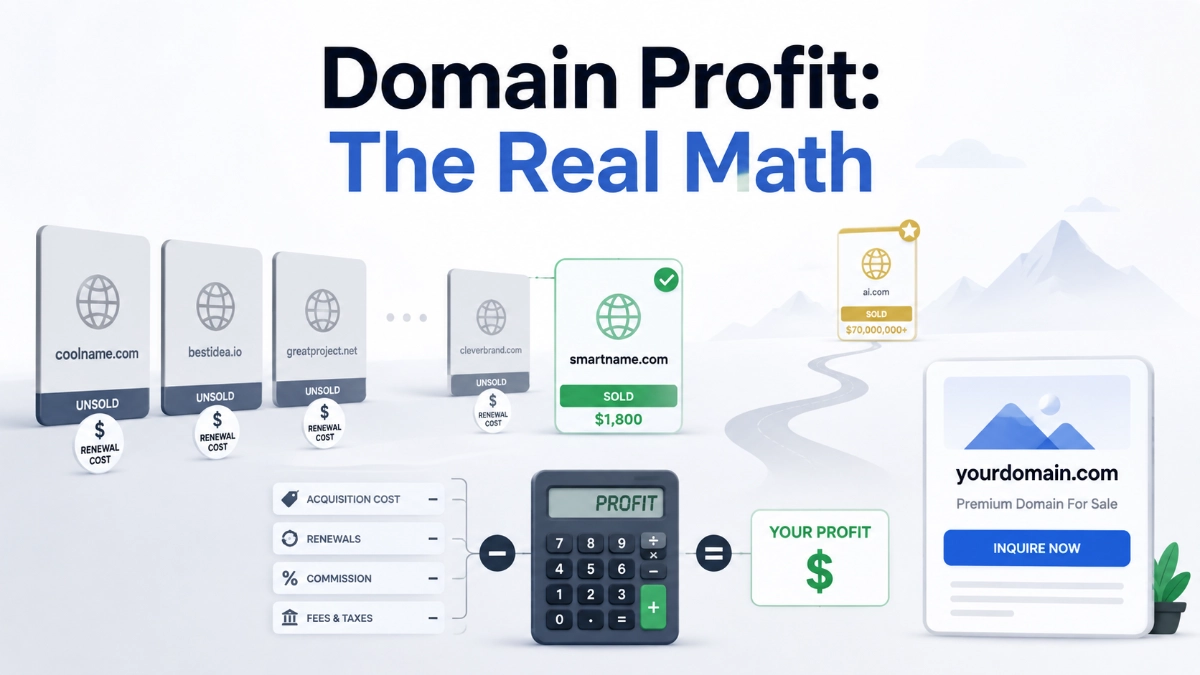

Here’s the honest answer to how much can you make selling domains: publicly reported sales range from a few dollars above registration cost to eight-figure deals like the $70 million reported for AI.com — and neither end of that range tells you what you’ll earn. The headline sales are extreme outliers. Most speculative domains don’t sell in any given year, and plenty are renewed for years or quietly dropped without ever receiving an offer.
Profitable sellers treat domains as inventory with carrying costs, not lottery tickets. What you actually make depends on what you paid, the quality of your names, how often anything sells, your selling price, and the commissions and renewal fees along the way. This article walks through the verified big sales, the realistic price tiers, and — more useful than either — the portfolio math most income articles skip.
Key Takeaways
- Publicly reported domain prices range from small sales to exceptional eight-figure transactions like Voice.com and AI.com.
- Headline sales are outliers and shouldn’t be treated as typical earning potential for a new domain seller.
- A domain’s sale price is revenue, not seller profit — reported prices don’t reveal what the seller paid or spent along the way.
- Acquisition costs, annual renewals, marketplace commissions, escrow fees, and taxes all reduce what the seller keeps.
- Many speculative domains receive no buyer in a given year, while their renewal costs continue.
- A clear sale page helps interested buyers contact the owner, but it does not create demand by itself.
Table of Contents
What “Real Data” Can and Cannot Tell Us
Before any numbers, a short honesty check. Public domain-sale databases contain only reported sales — many transactions are private or covered by nondisclosure agreements, and unusually high prices get far more attention than ordinary ones. So public sales lists show what has happened at the visible top of the market, not what a new investor should expect.
This creates survivorship bias: when you only see the winners, the game looks easier than it is. Nobody publishes a list of the millions of domains that expired unsold. A sale price also doesn’t reveal profit — the seller’s acquisition cost, years of renewals, commission, and taxes are usually unknown. And no meaningful “average domain sale” can be calculated from a list dominated by selected public sales. Keep all of that in mind as you read the next table.
The Headline Domain Sales Everyone Quotes
| Domain | Reported price | Transaction or report year | Evidence type | Important context |
|---|---|---|---|---|
| AI.com | $70 million, reported as paid in equivalent cryptocurrency | Publicly disclosed February 2026; confirm transaction closing period | Broker announcement plus established industry and financial reporting | Exceptional two-letter, category-defining domain; buyer reported as Crypto.com founder Kris Marszalek |
| Voice.com | $30 million in cash | 2019 | Confirmed in seller MicroStrategy’s SEC filing | Domain-only cash transaction; buyer Block.one |
| Chat.com | $15.5 million | Sold early 2023; price confirmed 2024 | Established domain-industry reporting | Price disclosed after the sale; later resold to OpenAI on undisclosed terms |
| NFTs.com | $15 million | 2022 | Established domain-industry reporting | Category-defining name sold at the peak of NFT interest |
| Sex.com | $13 million | 2010 | Established domain-industry reporting | Long-documented premium name with a complicated ownership history |
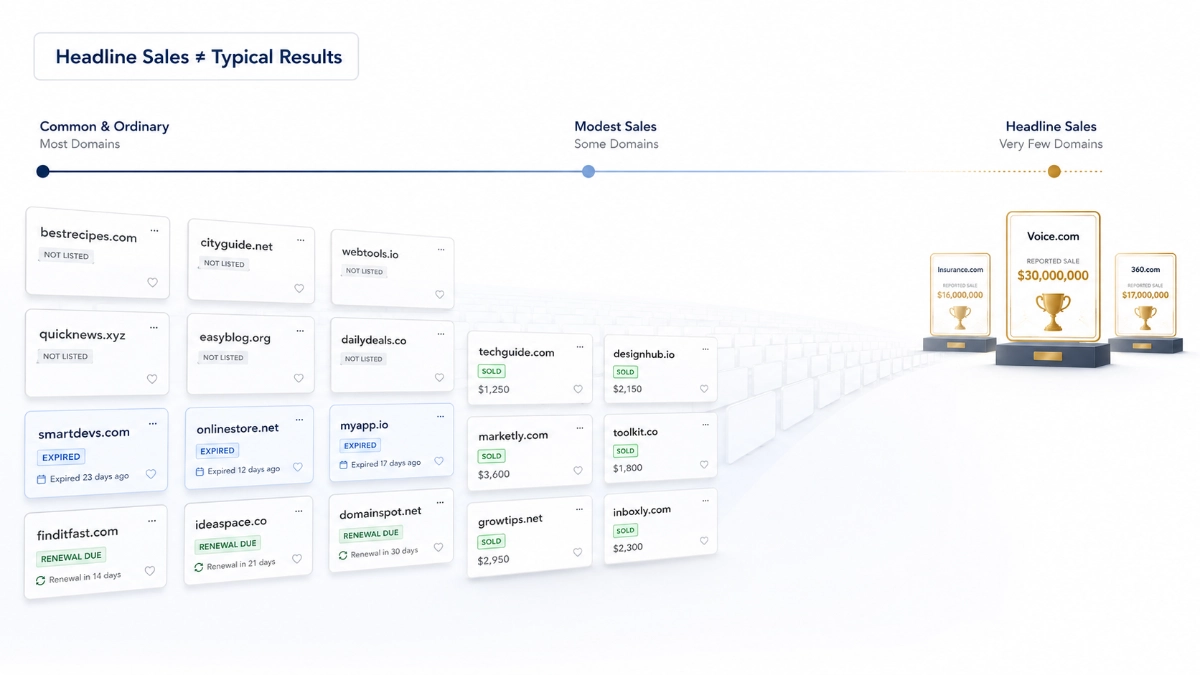
Public domain-sale records include only transactions that were reported or independently documented. Many sales remain private, and reported sale prices do not reveal the seller’s acquisition costs, renewals, fees, taxes, or actual profit. Figures were checked on July 19, 2026.
These transactions are comparable to trophy assets. They establish the top of the market, not the center.
What the table proves is that extraordinary outcomes are possible. What it doesn’t show is what an ordinary portfolio earns. These domains are short, category-defining, and globally obvious — characteristics almost no newly registered domain can replicate. And remember: the table reports prices, not seller profits.
Famous Domain Figures You Should Not Treat as Clean Sales
Cars.com
You’ll see “$872 million” attached to Cars.com in many roundups. That figure comes from a corporate transaction and accounting valuation connected to Gannett — an assessment tied to the business built on the domain, not a buyer writing a check solely for the name. It belongs in a different category than a domain-only cash sale.
Insurance.com
The $35.6 million QuinStreet paid in 2010 included website and media assets alongside the name, so it shouldn’t be compared directly with a verified domain-only cash sale like Voice.com. We flag these not to embarrass other publishers, but because “Real Data” in our title has to mean something.
How Much Do Domains Actually Sell For?
There’s no single meaningful average — the market mixes fundamentally different buyers and assets. Descriptive tiers are more honest than a fake statistic.
Registration-Fee or Below-Cost Exits
Some domains sell for little more than their registration or renewal cost — the seller is recovering money, not making it. Many others are simply dropped at renewal time without ever selling. This unglamorous tier is a real part of the market that income articles rarely mention.
Wholesale or Investor-to-Investor Sales
Investors buy from each other at prices that leave room for resale — that’s the point of a wholesale purchase. These deals typically close well below what an end user (a business that wants to actually use the name) might pay. [ILLUSTRATIVE RANGE: Not an industry average. Confirm against a recent sample of reported sales before publication.]
Entry-Level End-User Sales
A small company or individual buying a name they intend to use will usually pay more than another investor would. High-three-figure and lower-four-figure asking or selling prices are common reference points in many beginner discussions, but they are not guaranteed market averages.
Strong End-User Sales
Stronger commercial names can reach mid-four-figure or five-figure prices when several factors line up: clear commercial use, memorability, a strong extension, a buyer with budget, few comparable alternatives, legal safety, and brandability. Note what’s not on that list — being short or one-word doesn’t automatically make a name valuable if nobody has a reason to buy it.
Premium and Trophy Domains
The strongest category-defining names sell for six, seven, or occasionally eight figures — the tier the headlines come from. It’s the least useful tier for forecasting a beginner’s income, for the same reason penthouse sales don’t predict what your house is worth.
Revenue Is Not Profit
This is the distinction that separates honest answers from hype. The working formula: net domain profit = sale proceeds − acquisition cost − renewal costs − marketplace or escrow fees − tools and outreach costs − applicable taxes. Let’s take the terms one at a time.
Acquisition Cost
What you paid to get the name: a hand registration at standard price, an expired-domain auction win, a marketplace purchase, or a private acquisition. Auction and marketplace acquisitions can cost far more than registration — which raises the bar the eventual sale has to clear.
Carrying Cost
Every unsold domain renews annually, and renewal fees arrive whether or not anyone inquires. This is how a portfolio loses money even when a few domains sell — the winners have to cover the carrying cost of everything else.
Selling Cost
Marketplace commission, brokerage fees, escrow charges, checkout fees, banking, and currency conversion all come out of the sale price before anything reaches you.
Operating Cost
Research tools, hosting, email, landing-page software, outbound prospecting, and occasional legal or accounting help. Small individually; real in aggregate.
Taxes
Tax treatment depends on your jurisdiction and circumstances — sale proceeds are generally taxable income in some form. Talk to a professional; this article can’t give individualized tax advice.
The Math Nobody Shows You
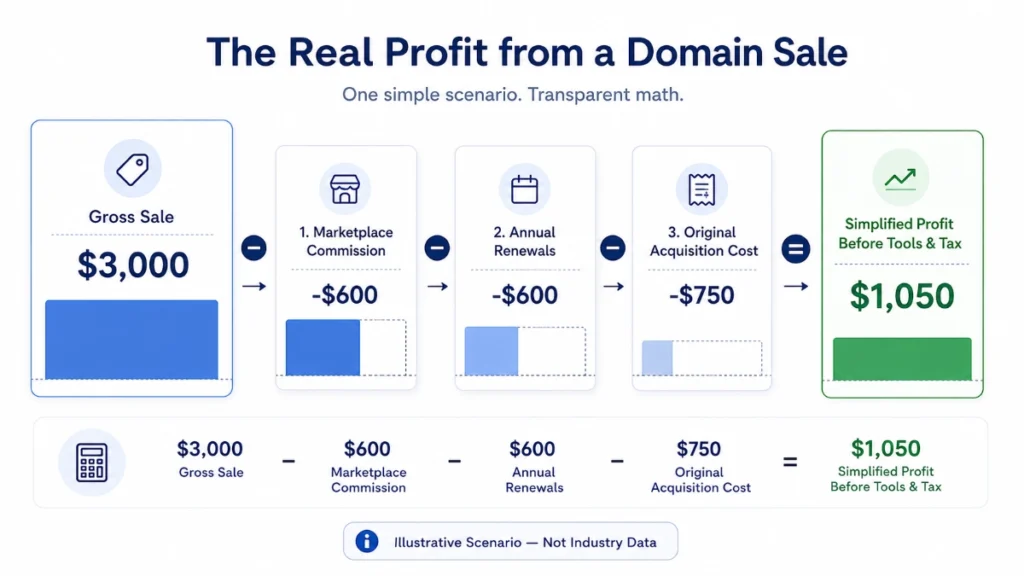
Let’s run three small-portfolio scenarios with every assumption visible. These use round numbers so the mechanics are easy to follow — registrar prices vary, the assumed commission is not a universal marketplace rate, and one sale doesn’t establish an expected annual sell-through rate.
Scenario 1: A 50-Domain Portfolio With One Sale
Illustrative scenario — not industry data. Assume 50 domains acquired at $15 each ($750 total), renewals of $12 each ($600 per year), one $3,000 sale during the year, and a 20% marketplace commission ($600). Tools, labor, and taxes are excluded.
The math: $3,000 gross, minus $600 commission leaves $2,400. Subtract the year’s $600 in renewals and the annual cash result is $1,800. Subtract the original $750 acquisition cost and the simplified lifetime result, before tools and tax, is $1,050. A genuinely positive outcome — from a $3,000 headline sale that shrank by nearly two-thirds on its way to being profit.
Scenario 2: The Same Portfolio With No Sale
Illustrative scenario — not industry data. Same 50 domains, same costs, zero sales — a year many real portfolios experience. Revenue: $0. Renewals: $600, so the annual operating result is negative $600, and the first-year cash committed including acquisition is negative $1,350. Nothing went wrong in this scenario; nobody happened to want these names this year. This is why weak inventory becomes expensive.
Scenario 3: One Directly Generated Buyer
Illustrative scenario — not industry data. Same portfolio and the same $3,000 sale, but the buyer arrives through the seller’s own sale page: 0% marketplace commission, with a closing cost instead. [ASSUMPTION: an illustrative $100 escrow/closing cost is used here; insert the current rate of your chosen service before publication.] Proceeds: $2,900. After $600 in renewals: $2,300. After the $750 acquisition cost: $1,550 — compared with $1,050 in Scenario 1. That $500 gap is marketplace commission avoided before other transaction expenses, not guaranteed profit, and it only exists because a buyer showed up at all.
What Happens When the Portfolio Is Larger?
Scaling up cuts both ways. More domains mean more potential buyer entry points — and more renewal liability, more administration, more pricing decisions, and a greater risk of quietly accumulating weak inventory. A small collection of commercially useful names can be financially healthier than a large portfolio of names nobody needs. Beginners don’t need hundreds of domains; they need better first purchases.
What Separates Profitable Domain Sellers?
They Buy Selectively
Profit is mostly determined at acquisition. Not registering a weak name is far easier than trying to sell one later — every skipped bad purchase is renewal money saved.
They Understand the Likely Buyer
A valuable domain has plausible end users with a reason and a budget to buy it. If you can’t name the kind of business that would want it, that’s the answer.
They Price for the Market
Wholesale price, retail end-user price, aspirational price, and liquidation price are four different numbers for the same domain. Knowing which one applies to which situation is a core skill.
They Control Renewal Costs
Disciplined sellers prune. Sunk-cost thinking — “I’ve already renewed it three times” — leads to renewing names that will never sell. Past renewals are gone either way.
They Respond Professionally
Slow, vague, or aggressive replies lose legitimate buyers. Prompt, clear, businesslike communication regularly rescues deals that hesitant sellers fumble.
They Make the Domain Reachable
A buyer can’t make an offer to an error page, an abandoned old website, an empty server page, a generic parked page with no inquiry path, or a stale marketplace listing. Every independently managed domain should lead somewhere with a clear next step — a self-hosted landing page, a marketplace sales lander, a portfolio page, or a verified Buy Now page. Which one is right varies by domain; having none is the only wrong answer.
Creating a Direct Sale Page With Domain For Sale
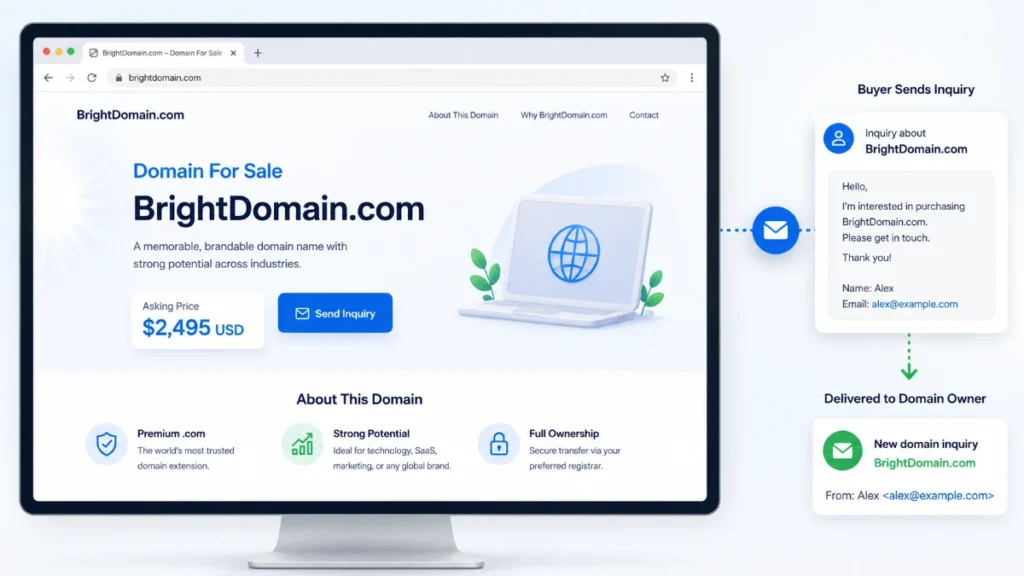
For the self-hosted option, the free Domain For Sale plugin for WordPress builds the sale page: professional landing-page templates, fixed-price or offer-oriented presentation, buyer inquiry and offer forms, centralized offer management, email notifications, customizable layouts, and listings for individual domains or a whole portfolio. The Pro version adds advanced workflows, including Escrow.com purchase forms and private Escrow invitations, for sellers who need them.
To be clear about what it doesn’t do: it doesn’t generate buyers, appraise domains, guarantee offers, hold funds, or transfer domains. It gives the buyers who do arrive a professional way to reach you — which, as the scenarios above showed, is exactly the moment where commission math starts mattering. How to Set Up a Domain For Sale Landing Page in WordPress For the strategy side, see our guide on how to sell a domain without paying commission.
How Long Does It Take to Sell a Domain?
There’s no dependable universal holding period. A buyer may appear in a week; a name may sit for years; the seller may cut the price, sell wholesale, or eventually let it expire; some domains never receive a serious inquiry at all. Domain investing is usually closer to holding illiquid inventory than actively trading a liquid asset — buyers are infrequent, each domain is unique, there’s no guaranteed market maker, valuation is subjective, and carrying costs continue while you wait. Budget for years, and treat a fast sale as a pleasant surprise.
Is Domain Flipping Passive Income?
Not really. A domain can sit passively, but a profitable portfolio requires research, acquisition decisions, pricing, renewal calls, landing-page upkeep, inquiry responses, negotiation, fraud checks, payment coordination, transfers, and recordkeeping. It can be a flexible side business with modest weekly effort — but “buy names and wait for money” is not an accurate description of how anyone does this profitably.
Common Ways Beginners Lose Money
- Registering names with no plausible buyer
- Buying too many domains too quickly
- Ignoring trademark risk
- Confusing asking prices with completed sales
- Renewing everything because of sunk cost
- Pricing every domain like a trophy asset
- Paying auction prices without a resale plan
- Forgetting commission and renewal expenses
- Assuming an automated appraisal is a guaranteed sale price
- Leaving domains without a clear inquiry path
- Transferring a domain before payment is secured
Choosing where to list is its own decision — see 10 Best Places to Sell Domain Names in 2026 and Afternic vs Selling Domains on Your Own Website for the channel comparison, and How to Accept Domain Payments Securely With Escrow.com in WordPress before closing your first deal.
Frequently Asked Questions
Is domain flipping still profitable in 2026?
Yes, for some disciplined sellers — but it isn’t guaranteed or easy income. Profitability depends on inventory quality, purchase prices, renewal control, the sales channels you use, patience, and whether real buyer demand exists for your names. Sellers who buy selectively and prune ruthlessly can do well; sellers who accumulate weak names mostly fund registrars. No trustworthy industry-wide profitability percentage exists, and you should be suspicious of anyone quoting one.
How much do domain names sell for on average?
There’s no single meaningful average. The reported market mixes low-value wholesale trades, retail end-user sales, premium domains, developed websites, private transactions, different extensions, and different channels — averaging across them produces a number that describes nothing. It’s more useful to think in tiers: below-cost exits, wholesale deals, entry-level end-user sales, strong end-user sales in the four-to-five-figure range, and the rare premium tier the headlines celebrate.
How many domains do I need to make money?
There’s no fixed number, and more isn’t automatically better — every additional domain adds renewal liability. Ten strong names with plausible buyers can outperform hundreds of weak ones. Size your portfolio to your research ability, renewal budget, pricing discipline, buyer access, and risk tolerance. If your renewal bill makes you uncomfortable, the portfolio is too big for its quality level.
What makes a domain valuable?
Commercial usefulness first: someone must have a reason and a budget to buy it. Beyond that — memorability, reasonable length, clarity when spoken aloud, a strong extension, brandability, search or category relevance, a real pool of potential buyers, few good alternatives, and freedom from trademark problems. Age alone doesn’t create value, and neither does an automated appraisal score.
Can I make money selling only one domain?
Yes — it depends entirely on the domain and buyer demand. Plenty of people have sold a single well-chosen name for a meaningful amount, sometimes one they registered years ago without an investment plan. But one successful sale is an event, not an income strategy; repeating it requires the acquisition and pricing discipline this article describes. If you own one good name, give buyers a clear way to reach you.
Do I need a website to sell a domain?
No — but the domain needs a clear buyer contact path of some kind. Options include a marketplace listing, a marketplace-hosted lander, a self-hosted sale page, direct outreach to likely buyers, or a privately negotiated deal. A self-hosted page offers the most control and no marketplace commission on the leads it captures; marketplace landers offer distribution instead. What fails is a domain that resolves to nothing, because interested buyers rarely go hunting for the owner.
Conclusion
So, how much can you make selling domains? Anywhere from a loss to — in genuinely rare, well-documented cases — millions. The extraordinary sales are real, and they’re terrible income forecasts. Most speculative inventory sells slowly or not at all, revenue is not profit, and the sellers who come out ahead are the ones with acquisition discipline, controlled renewals, market-based pricing, and the patience to budget for years without a completed sale.
If you already own domains, start with the step that costs nothing and requires no forecast: make sure every independently managed name gives an interested buyer a clear way to inquire. The free Domain For Sale plugin sets up that sale page in WordPress. It won’t create demand — nothing on a shelf does — but when a buyer does arrive, you’ll be reachable, professional, and negotiating on your own terms.