


A buyer lands on BrightLedger.com. The page says: “Premium domain for sale. Make an offer.” That technically tells them what to do, but it says almost nothing about what kind of business the name suits, why it’s memorable, what the asking price means, or what happens after they submit an offer.
Good domain sales copy doesn’t need to be long. It needs to be specific, honest, and useful to the buyer standing in front of it. This guide covers domain sales page copywriting — what to actually write, where that copy lives inside Domain For Sale, and where sellers commonly go wrong.
wpdomainforsale.com is operated by ThemeAtelier, the developer of Domain For Sale. Product-specific examples below are mapped to the current plugin interface (v3.7.0); copywriting recommendations are practical guidance, not guaranteed sales outcomes.
Key Takeaways
- A domain sales page should explain relevance, sale terms and next action — without inventing value that isn’t there.
- “Premium domain” means little unless the page explains specifically what makes the name useful.
- The short Listing Tagline and the longer Description should do different jobs, not repeat each other.
- Copy should change depending on whether the domain is Fixed Price, Make an Offer, or accepting bids — Domain For Sale currently supports all three.
- Concrete facts (length, extension, genuine history) are stronger than unsupported superlatives like “rare opportunity.”
- Urgency copy should only describe something real — a real deadline, a real price change — never an invented one.
- Domain For Sale separates domain-specific copy (Tagline, Description) from reusable template copy, so one design can serve many domains without repeating the same pitch.
Table of Contents
Start With the Buyer’s Question, Not a Generic Pitch
Every useful domain description answers one question first: why might this particular name be relevant to me? Pick two to four plausible buyer types rather than claiming universal appeal, then let the domain name itself stay visually dominant — the surrounding copy supports it, it doesn’t bury it.
Weak: “Perfect for any business.” Better: “A concise name for bookkeeping software, accounting automation, or a small-business finance platform.” The second version gives a buyer something to recognize themselves in. It doesn’t imply trademark availability or exclusive rights — just plausible fit.
Avoid filler openers like “Premium domain,” “Rare opportunity,” or “Amazing name” unless the sentence right after actually explains why. Empty superlatives read as generic to buyers who’ve seen a hundred other listings say the same thing.
How to Write the Listing Tagline
Domain For Sale’s Listing Tagline is a domain-level field — short positioning copy that shows up wherever the product surfaces the domain in a compact form. Treat it as one line, not a headline you can pad with extra clauses.
Use the pattern [what it suggests] + [who it may suit]. For BrightLedger.com, a weak tagline reads “Premium financial domain for sale.” A stronger one reads “A clear brand name for accounting, bookkeeping, or finance software.” Don’t claim the tagline will rank, convert, or build authority — those are outcomes copy alone can’t promise.
How to Write the Domain Description
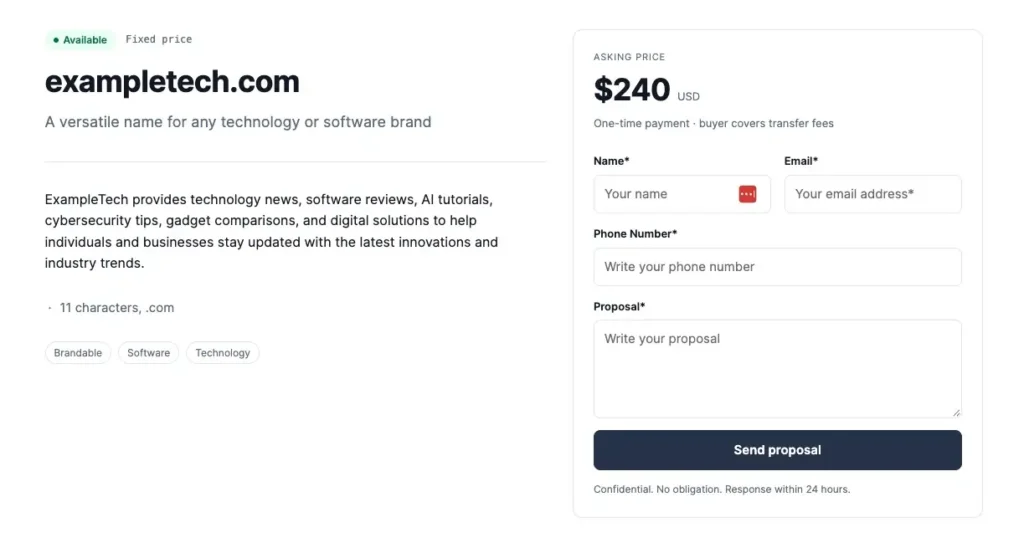
The Description field can do more work than the tagline, but “more work” doesn’t mean more words. A useful description answers four things in order: what the name communicates, who might plausibly use it, what’s objectively true about it, and what the buyer should do next.
- What it communicates — the plain-English meaning or association of the name.
- Plausible use cases — two or three realistic buyer categories, not every business imaginable.
- Objective characteristics — length, extension, spelling simplicity, or a real dictionary-word combination.
- Sale terms and next step — what happens when the buyer clicks the button.
Most domains need only a few focused sentences. Save longer descriptions for higher-value names with genuine, documented history — padding a weak name with more words doesn’t make it stronger.
Facts vs. Unsupported Claims: What You Can Honestly Say
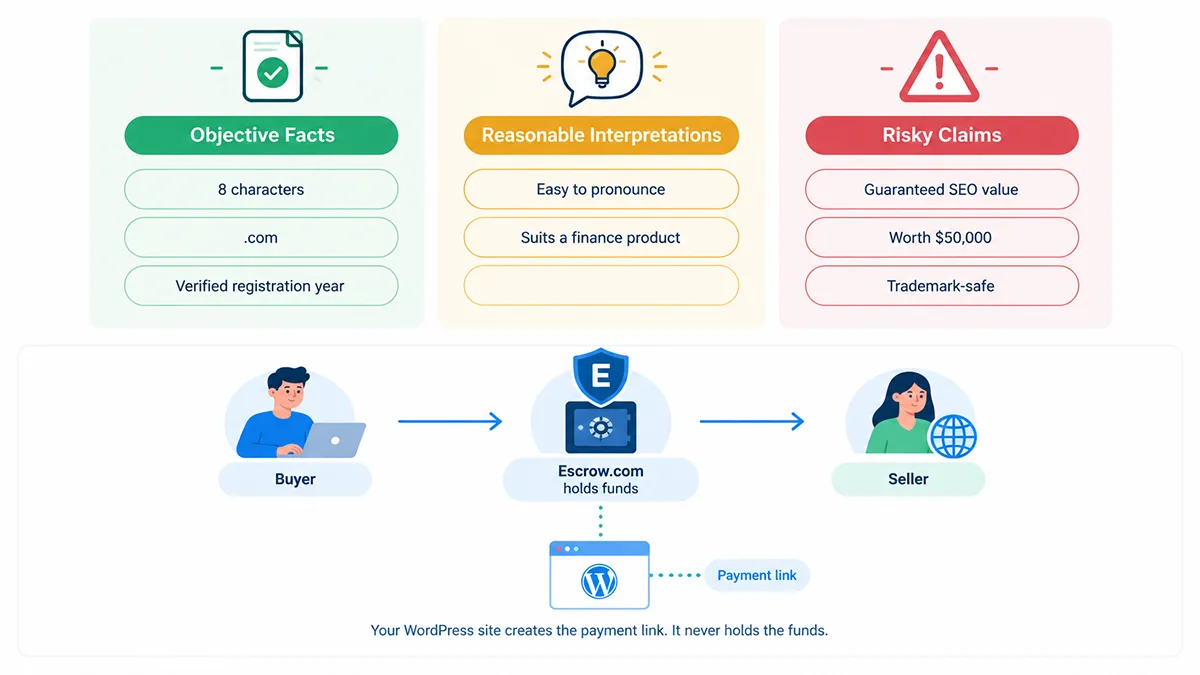
Every domain has objective facts and reasonable interpretations — and a line where interpretation turns into an unsupported promise. Knowing which side of that line a sentence falls on is the single most important copywriting skill for this page.
| Category | Examples |
|---|---|
| Objective (safe) | 8 characters; .com; two common dictionary words; verified registration year; current asking price |
| Reasonable interpretation | Easy to pronounce; suitable for a finance product; suggests speed or simplicity |
| Unsupported or risky | “Guaranteed SEO value”; “will rank #1”; “worth $50,000” with no valuation basis; “hundreds of buyers want this”; “trademark-safe” |
A few specific traps worth naming. Domain age is a fact, not SEO authority — an old registration date alone doesn’t establish rankings, backlinks, or trust. Length is a real characteristic (shorter names may be easier to type and remember), but “short domains always sell for more” isn’t defensible. An extension like .ai can reinforce a name’s positioning, but no extension is universally better.
Keyword relevance doesn’t guarantee rankings, so avoid phrasing like “will rank higher in Google” — “directly describes accounting software” is the honest version of the same idea. If you mention traffic or backlinks at all, cite the source and measurement period or leave the claim out entirely. And since owning a domain doesn’t guarantee trademark clearance, one honest sentence is enough: buyers should run their own trademark and legal checks before adopting a name as a brand.
Copy by Sale Method: Fixed Price, Make an Offer, and Bids
Domain For Sale currently supports three sale methods per domain — Fixed Price, Make an Offer, and accepting bids — and the copy around each should reduce uncertainty about what happens after the click, not just what the domain is worth.
Fixed Price copy should state the number plainly. “Purchase for $2,500” tells a buyer more than a vague “Get Started” button when the next action is actually a purchase. Don’t manufacture urgency around a fixed price that isn’t changing.
Make an Offer copy should confirm the domain is genuinely for sale and invite serious offers without hostility. “Interested in BrightLedger.com? Submit your offer below and include any details that may help the seller evaluate it” works better than “Serious buyers only, lowballers ignored,” which creates friction for no benefit.
Bids copy should explain what the buyer is actually submitting — a bid against a minimum next amount, resolving to one winner at a set deadline — not implied as a live timed-auction spectacle if that’s not what’s happening. Keep terminology accurate throughout: asking price, starting price, minimum offer, and reserve mean different things, and mixing them up confuses buyers about what they’re agreeing to. For the pricing-strategy decision behind these numbers, see our domain pricing guide; for form-level setup, see the Make an Offer form guide.
Trust, Urgency and Escrow Copy — Without the Tricks
Urgency only works when the underlying fact is real. “Offer valid until September 20” or “Price changes on October 1” are fine if the seller genuinely means them. “Several buyers are interested” when they aren’t, or displaying “0 offers” as if it were social proof, does more harm than saying nothing.
Trust copy works better when it’s concrete: clear seller contact information, an understandable transaction process, accurate pricing, and professional form language. Don’t invent testimonials or “verified seller” badges — Domain For Sale’s product doesn’t include a testimonial field, so don’t imply one exists.
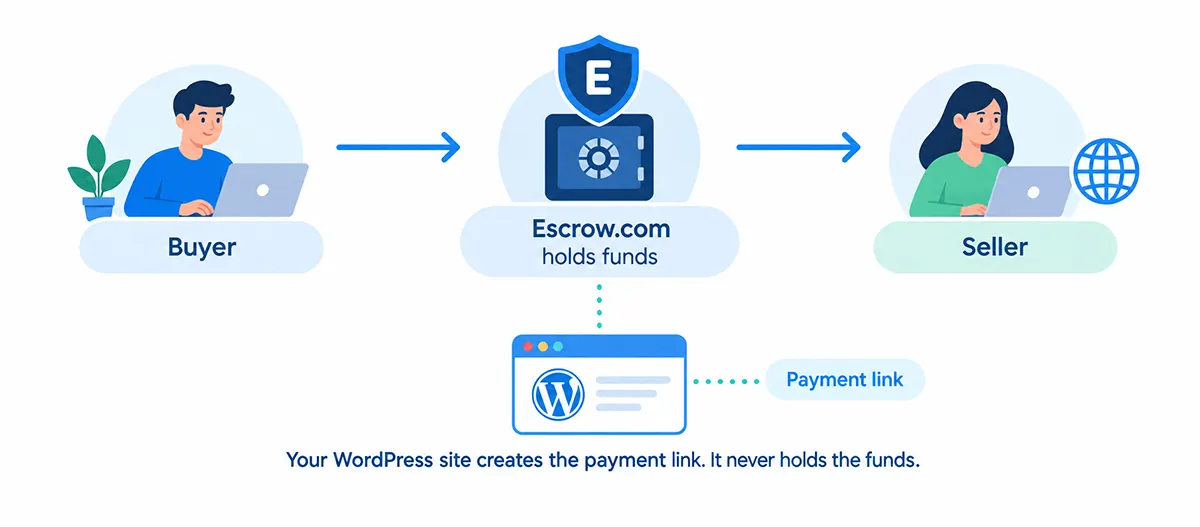
Where Escrow.com is configured, describe it accurately: Escrow.com handles the transaction and holds the funds, not your WordPress site. The plugin generates the payment link and shows you the transaction status — it never takes custody of the money itself. Calling every offer form “secure” just because it exists overstates what’s actually happening; save that word for the parts of the flow that are genuinely handled by a licensed third party. See our Escrow.com setup guide for the full transaction path.
Match Copy to Buyer Type and Domain Type
An end user cares about brand relevance, business fit, and a clear transaction process. A domain investor evaluates acquisition price, resale potential, and comparable sales. Since a seller usually can’t know which one is reading, default copy should favor clear factual positioning over aggressive persuasion aimed at either.
Domain type changes the angle, too. A brandable name leans on pronunciation and imagery. An exact-match or descriptive domain leans on what the phrase directly communicates. A local domain pairs geography with a service category. A short domain should explain brevity as a real characteristic, not an automatic valuation.
Before/After: Four Real Rewrites
The examples below use fictional domain names for illustration — availability is not implied. Each pair shows the same underlying facts, written two ways.
Finance — BrightLedger.com
Weak tagline: Premium financial domain for sale.
Improved tagline: A clear brand name for accounting, bookkeeping, or finance software.
Weak description: Premium domain for sale. Make an offer. Great for any business looking for a professional name.
Improved description: BrightLedger.com pairs two plain English words that read clearly to any audience. The name suits accounting software, a bookkeeping service, or a small-business finance app. Eight characters, .com, no hyphens or numbers. Offers are open — include how you’d use the name with your submission.
Why it’s better: Specific use cases and objective facts replace filler adjectives, and the CTA states the real next step instead of a vague promise.
AI/SaaS — PilotStack.ai
Weak tagline: Rare AI domain opportunity.
Improved tagline: A short .ai name for a flight-ops, automation, or copilot-style AI product.
Weak description: Amazing AI domain! Perfect for any startup. Will only get more valuable.
Improved description: PilotStack.ai combines an aviation-flavored word with a common SaaS suffix, which reads naturally for automation, ops-copilot, or workflow tools. The .ai extension reinforces an AI-first product. Fixed price of $1,800 — buy now, or ask a question below.
Why it’s better: Drops the unsupported valuation claim, names plausible use cases, and states the fixed price plainly.
Local Service — AustinPipePros.com
Weak tagline: Great local domain.
Improved tagline: A direct name for a plumbing or pipe-repair business serving Austin.
Weak description: Local domain for sale. Good for SEO. Contact us for details.
Improved description: AustinPipePros.com pairs a recognizable city name with a clear service category — useful for a plumbing, pipe-repair, or drain-service business in the Austin market. It directly describes the service rather than relying on an invented brand. Make an offer below, and include your intended use if you’d like that context considered.
Why it’s better: Removes the vague SEO promise and replaces it with what’s actually true: direct relevance to a real service category.
Ecommerce/Brandable — LoomVale.com
Weak tagline: Perfect domain for any company.
Improved tagline: A soft, brandable name suited to home goods, textiles, or a lifestyle ecommerce brand.
Weak description: Rare brandable name. Everyone wants domains like this. Buy now before it’s gone.
Improved description: LoomVale.com combines two evocative words that suggest craft and place without describing one specific product — useful for home goods, textiles, or a broader lifestyle ecommerce brand. Nine characters, .com, easy to pronounce and spell. Starting bid is $500; bidding closes when a reserve is met.
Why it’s better: Cuts the fake urgency and unverified demand claim, keeps the real facts, and matches the CTA to the actual bidding mechanism.
A Simple Domain Sales Page Copywriting Formula You Can Reuse
This isn’t a scientifically proven system — it’s an editorial framework that keeps copy specific instead of generic.
- Tagline formula: [category or use case] + [specific name quality], one line.
- Description formula: identify the plausible buyer, explain what the name communicates, include one to three truthful characteristics, state the sale terms, end with one clear action.
Where This Copy Actually Lives in Domain For Sale
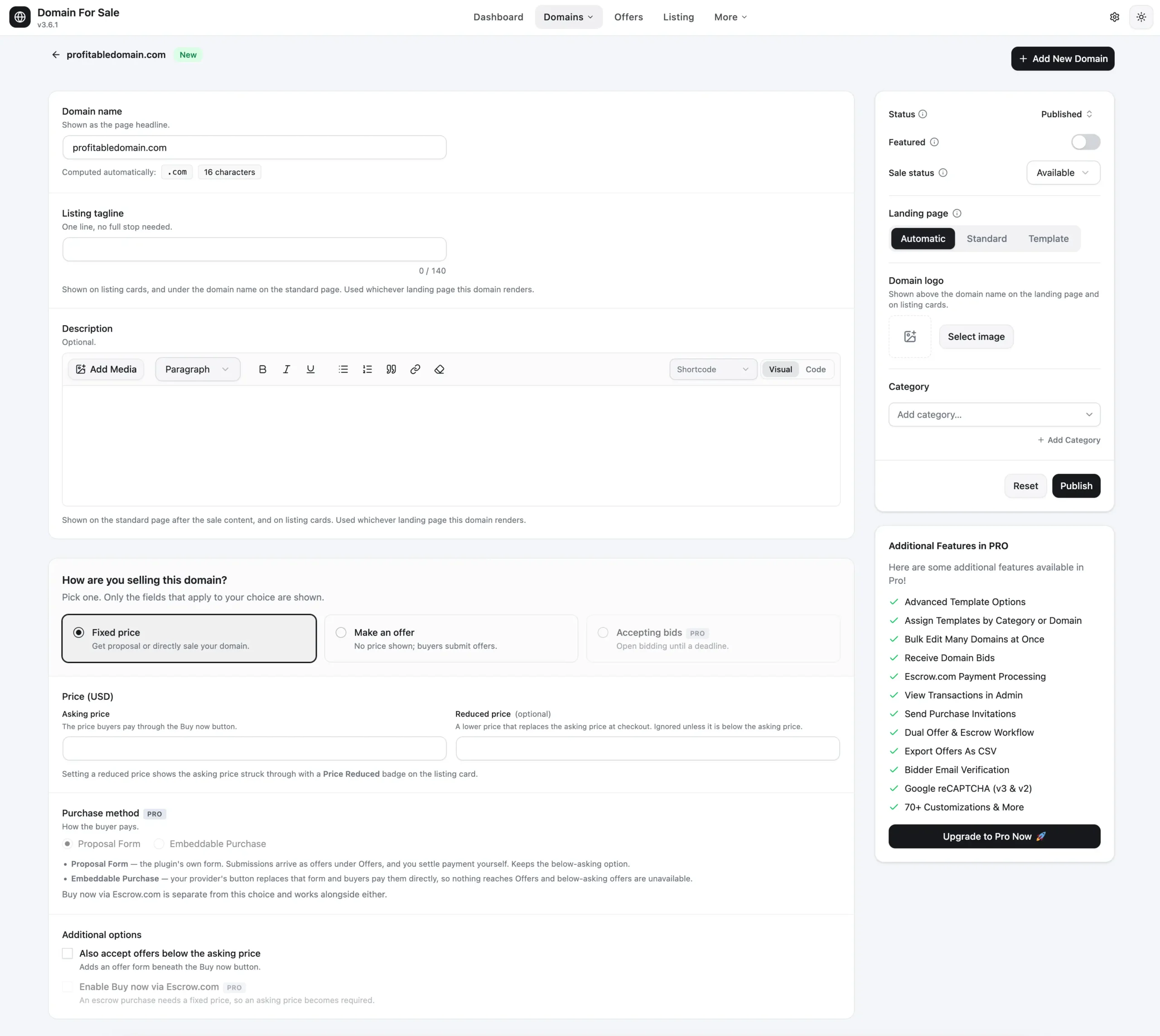
Since the plugin’s 3.6.0 architecture update, domain-specific copy and reusable template copy are deliberately separate objects. Getting this distinction right prevents one template’s generic wording from either duplicating or contradicting a domain’s own positioning.
| Copy Element | Where It Lives | Purpose |
|---|---|---|
| Domain name | Domain record | Main identity |
| Listing tagline | Domain record | Short, domain-specific positioning |
| Description | Domain record | Domain-specific explanation |
| Sale title | Template — Content Options | Reusable landing-page headline |
| Offer tag | Template — Content Options | Reusable offer-oriented message |
| Price tag | Template — Content Options | Price presentation, supports placeholders |
| Dynamic placeholders ({domain}, {price}, {length}, {extension}) | Template content | Reusable factual data instead of hand-written repetition |
Reusable template copy should stay generic enough to work across every domain assigned to it — “{domain} is a {length}-character {extension} domain available for acquisition” reads fine at scale. Domain-specific positioning, like the finance-software angle for BrightLedger.com, belongs in that domain’s own Tagline and Description, not baked into a shared template.
Two tiering notes worth knowing before you plan your copy: the {age} placeholder (which reads a domain’s registration date) is a Pro feature, and rewriting the sales-form field labels, placeholders, and success or error messages is also Pro-only — sellers on the free version work with the plugin’s default form copy as-is.
Common Copywriting Mistakes
- Calling a domain “premium” with no explanation of why.
- Claiming a name is “perfect for any company” instead of naming two or three real buyer types.
- Making SEO, valuation, traffic, or backlink claims with no evidence behind them.
- Inventing urgency or buyer interest that doesn’t exist.
- Writing 500 words when three precise sentences would do — or hiding the price and sale terms inside them.
- Reusing the exact same description across an entire portfolio instead of writing domain-specific positioning.
- Putting highly specific domain positioning inside a shared template meant to serve many unrelated domains.
- Confusing starting price, asking price, and minimum offer, or implying Escrow protection that isn’t actually configured.
Frequently Asked Questions
What should I write on a domain-for-sale page?
Cover four things: a plausible use case, one or two truthful characteristics, the price or offer terms, and a clear next action. Skip generic superlatives that don’t tell the buyer anything specific.
How long should a domain description be?
There’s no universal word count. Most domains need only a few focused sentences; higher-value names with genuine documented history may justify more detail. Padding weak copy with extra length doesn’t make the domain more valuable.
Should I call my domain “premium”?
Only if the surrounding sentence explains the actual basis — length, extension, real history, or clear brand fit. Used as filler with no explanation, “premium” tells a buyer nothing they can act on.
Should I set a fixed price or ask buyers to make an offer?
That’s a sales-strategy decision, not a copywriting rule — see our domain pricing guide for the tradeoffs. Whichever method you choose, Domain For Sale supports Fixed Price, Make an Offer, and bidding, and the copy should match whichever one you’ve configured.
Can I say a domain is good for SEO?
Be cautious. Keyword relevance in a domain doesn’t guarantee search rankings. It’s accurate to say a name “directly describes” a topic or service; it’s not accurate to promise it will rank well.
What’s the difference between the Listing Tagline and the Description in Domain For Sale?
The Listing Tagline is a short, domain-level line meant for compact contexts like portfolio views. The Description is domain-level too, but longer — room to cover use cases, objective facts, and sale terms in full sentences.
Conclusion
A domain’s name and price do most of the heavy lifting — copy can’t manufacture value that isn’t there. That’s the core of domain sales page copywriting: clarify genuine value by explaining who the name suits, stating what’s objectively true, and making the next step obvious.
Start by writing one honest tagline and one four-part description for your strongest domain, using the formula above. Then check it against the facts-vs-claims table before you publish. For the full landing-page structure this copy fits into, see our high-converting landing page guide.